eJournal 8: “Distance Education”

“Education is the most powerful weapon which you can use to change the world.”

Nelson Mandela
Blended and Online Learning : Persepsi Siswa dan Kinerja
https://sites.google.com/?tab=i31&authuser=0

Since the past 2 weeks, my school has started applying “Distance Learning” due to the rapid outbreak of the Coronavirus pandemic. Just like any other topic of discussion, according to me, online learning holds its own benefits as well as disadvantages.

Firstly, distance learning is beneficial to me because I don’t have to get up as early as I would when going to school. In my opinion, the biggest blessing to any student is being able to get that little bit of extra sleep because every minute counts.

Next, we can do our work at our own pace as the deadline of most of our assignments are usually at the end of the day therefore, we can do it anytime we want as long as we submit it on time. We can choose which subject tasks we want to do first and keep the rest for the last.

Followed by that, the risk for online classes being cancelled is lower than the risk of regular school being cancelled. Regular school can be cancelled due to a wide variety of reason such as floods, riots and possibly even pandemics, just like how we are currently experiencing. However, online classes avoids problems like this as we are learning under the safety of our own homes and we don’t need to go out to receive proper education.

As for its disadvantages, online classes can be disrupted if we have an unstable internet connection, which occurred to me once. This caused me to be unable to attend up to 3 of my online classes however, I managed to catch up on it by asking my friends what I missed. This can prove to be an inconvenience, especially in areas that often experience bad signal.

Secondly, in my personal experience, I get so much more work and tasks to complete in online school than in regular school. This makes me much more tired as I have numerous deadlines to meet everyday.

Sometimes, I also tend to take online learning less seriously than studying in school as I try to take as many breaks as I can fit in my schedule. Sometimes, I can be less focused and prove to be more distracted.

In conclusion, online learning has been an amazing and memorable experience for me as I have learned many new things from it, especially meeting several deadlines in just a matter of a few hours. The excessive assignments, tasks, work and due dates has taught me to procrastinate way less as I actually had to cope with so many things to do. Procrastination has always been one of my worst habits but due to online learning, I can confidently say that I am very close to getting rid of this trait. I also aspire to be more committed and dedicated to online learning as the days go by!

eJournal 7: SISMO 2020, A Mathematical Miracle

“Life is about taking chances, trying new things, having fun, making mistakes and learning from it.”

RKA Authement


Experience

SISMO was the first mathematics olympiad hosted by my school, SIS KG and coincidentally, it was also the first math olympiad I have ever joined. Hearing the fact that if we join this competition, we’ll be awarded an automatic 30% in our final semester report immediately grasped my full attention. I completely acknowledged that this was an amazing opportunity and it couldn’t be missed at any cost.

I attended the competition without any aims, goals, expectations or intentions. I simply came to receive the 30% on my report card, without any hopes of achieving an award. However, to my surprise, I came home bagging a gold medal and it was definitely one of the most shocking and unforeseen experience that has ever occurred to me. A huge lesson that I learned from SISMO is that we have so much more potential in ourselves than we think we do and that can only be discovered if we are willing to try new things. We are blessed with so many hidden talents and abilities, waiting to be unraveled when we dare to put in just a little bit of effort from our side towards new endeavours in life. The unexpected can truly come to life, and be one of the greatest miracles we’ve ever encountered.


Registration

At around 8 a.m, we were expected to be in front of the MPH for re-registration purposes. As soon as they saw us, they rechecked whether or not our name was on the list and then marked our attendance. Followed by that, they escorted us to our respective seats and the desks were assembled together in pairs where the person sitting next to us wasn’t doing the paper of the same level. This was very organised as besides preventing cheating, it also allowed us to interact with other people and make new friends, instead of constantly hanging around the same friend groups.


Ice Breaker: 24 Card Game

Source: SISMO Photographer

After all of us were settled in our positions, since we were unfamiliar with the people sitting around us, the 24 card game was introduced as a way to ‘break the ice’ between us. We played this game in fours and we had four random cards assembled in the middle of the desk. We are allowed to add, multiply, subtract and divide the numbers in order to result with 24. The first person to solve this wins the game and is then rewarded with a lucky draw with monetary values ranging from 5k – 100k. Something that definitely impressed me is that the youngest member in our group was the one who managed to win the game. Personally, I feel that this game successfully made us drill our minds and make us prepared for the upcoming test especially since it was really early in the morning. Besides breaking the ice, this challenge also happened to ‘unfreeze’ our brains.


Round 1

Source: SISMO Photographer

SISMO consists of two main rounds: Round 1 which is the multiple-choice questions and Round 2 which is the open ended-questions. As for Round 1, even though MCQ may seem like such an easy idea, we literally had to drill our minds to such an extent and in some cases, we may have even had to simply guess the answers as the questions could be regarding topics that we’re unfamiliar with. Overall, this was a really fun yet challenging experience which enabled me to gain a lot of new knowledge.


Round 2

As mentioned before, round 2 consisted of the open-ended questions. This round happened to be much more tricky as we couldn’t simply pick the answer from a bunch of given choices. We actually had to come up with our own values. To my surprise, I actually managed to get one of the questions right despite how confused and puzzled I was throughout the entire paper. This paper required our brains to work very efficiently and we had to remain very calm in order to process our thoughts well enough.


Kahoot & Lightning Round

As an end to the memorable experience, the top 3 scorers of the test were set to compete in a buzzer round against each other. This was very entertaining and amusing to watch as they were able to come up with answers for very tricky questions in just a matter of a few seconds.

Lastly, to conclude this event, we played a Kahoot as a fun end to it. I have never seen this many participants in a Kahoot and it was absolutely fascinating to witness how some people considered the Kahoot as a very serious game and became very competitive while others participated in it just for fun. The Halakatas also gave a beautiful performance and I can surely say that this is my favourite dance group, as they never fail to leave the audience with complete astonishment and wonder.


Awarding Ceremony

Source: SISMO Photographer

The wait is finally over. As my name was called on the microphone, I was left in shock and simply couldn’t believe that I was able to accomplish a gold medal. All I expected to receive was just a certificate of participation and I never anticipated to win such an honourable award. If I had the opportunity to join SISMO once again, I simply wouldn’t miss it for the world. It really taught me to not underestimate any of my capabilities.


IB Learner Profile

1. Open Minded: First of all, SISMO taught me to be open-minded regarding trying new things and grasping new opportunities. It showed me that despite the fact that I had to get up early to join this competition, it really did bring back fruitful results and it was extremely worth it.

2. Knowledgeable: This event enabled me to gain so much more knowledge about mathematics and showed me that there really is a lot more topics than we know of. We still have a whole new branch of maths that hasn’t been covered and due to SISMO, I was able to receive a glimpse of how it looks like.

3. Thinkers: This experience indeed made me drill my mind in order to get the right answer and I had to properly analyse complex problems so that I could understand it well enough to be able to solve it.

4. Communicators: The 24 card game made me talk to people I was unfamiliar with and actually get to know them. I spoke to different people from a variety of grade levels ranging from sec 1 all the way until JC 2.

5. Reflective: After each round, my friends and I compared our answers and discussed how we got them. This allowed us to learn new techniques and strategies to get the correct answer, which also contributed to our personal development as we could use this knowledge for further problems.

eJournal (Final Entry 2): “Mind-Boggling Mathematics”

“The key to success is to focus on goals, not obstacles.

Unknown


Introduction

I’m in my second year of the IGCSE programme and as of now, I’ve completed 1 & a half years of extended mathematics and fortunately, still alive and breathing. However, jokes aside, my experience in IGCSE has been going very well so far. I enjoy the variety of challenges that we’re continuously thrown with which enables us to discover a whole new intellect of our respective minds. I can certainly say that I’ve gained much more knowledge in these 1.5 years than I’ve ever had, thanks to our very own ‘KISH.’ I definitely look forward to completing the entire 2 years of IGCSE.

For our math semester assignment, we have to complete 3 different investigations that involves completely new concepts and ideas. This assignment helps us to train our minds in terms of IB, especially when it comes to analysis and approaches in maths. We are enabled to explore the innovative and creative side of this subject which requires us to use our own logic to derive its respective conclusions. This unravels our critical thinking skills, which is very useful in the long run. Despite how challenging and unfamiliar the tasks may be, once you get the hang of it, everything begins to connect to one another. There’s also many patterns that we can construct from the results which gives us the ability to predict the following values in the sequences.


Investigation A: Hit the Runway

desmos.com

For this investigation, we were told to graph a few linear equations that runs through the middle of the given runway. From those questions, we had to pick the one that seemed to look the best and then take a screenshot of it for our math blog. I found the linear equation by choosing two points from opposite ends of the runway and used the formula:
Y2 – Y1 / X2 – X1 to find the gradient. Due to this, I could find the slope, m, and it resulted in the equation: y= -0.6x + c. To find the y-intercept, c, I replaced x and y with one pair of the coordinates that I chose from the runway. Therefore, I ended up with the equation
y= -0.6x + 6.4.

This is how my linear graph looked which cut through the runway in the middle.

After finding this, we were told to seek our JC1 Math AA HL mentor for additional creative input. Apparently, there was a hidden question behind the mysterious runways. Most of us have heard or experienced a plane flying in a loop before it lands due to air traffic. Therefore, what we had to do was design and construct a route of the loop that the plane takes in the air using a graph equation that connects to the previous linear line. We were told to make it as creative as possible.

My JC1 mentor was Anushka and she gave me advice at every stage of the graph. After every change I made, I sent her a picture of it and she continuously gave me suggestions in order to make the route as nice and creative as possible. She encouraged me to graph and combine a few semicircles in order for the route to be established.

After numerous trials, this is how the route of my airplane looked. It consists of 3 different semicircles whose equations are all displayed on the left-hand side of the screenshot, along with the colour that each curve portrays.


Investigation B: Koch’s Snowflake

For this investigation, we had to derive the patterns from the different stages of contracting Koch’s snowflake. From this task, we also managed to construct a general formula to find the area and perimeter of other equilateral triangles as well. To construct the formula, we had to spot the different patterns first in order to identify the things they had in common with each other.

https://encrypted-tbn0.gstatic.com/images?q=tbn%3AANd9GcQurR468Yff4vmzdoPfj1s1KW9wlH58FyGBR1vVwID9cxMqovue

Perimeter of the snowflake at each iteration:

Displayed above is. the working to find the perimeter of the shape at each stage.
  • Stage 0: This is simply just an equilateral triangle therefore, all of its sides have equal lengths. So, we can just multiply 81 by 3 to get the perimeter.
  • Stage 1: Firstly, the length of the side of the initial triangle is 81 cm however, each side is now divided by 3 therefore, each side can now be labeled as 81/3. Then, we multiply it by 4 because each initial side now has 4 segments of 81/3. Lastly, we multiply it by 3 because a triangle has 3 sides.
  • Stage 2: The length of the side of the initial triangle is now divided by 9 so, the length of the new side can be written as 81/3 squared. Then, we multiply it by 16 because now, there is 16 sides of 81/3 squared on each side of the initial triangle. Lastly, we multiply it by 3 again because a triangle has 3 sides.
  • Stage 3: The length of the initial triangle is again further divided by 27 therefore, the new length can be written as 81/3 cubed. Then, we multiply it by 64 because there is now 64 sides of 81/3 cubed on each side of the initial triangle. Lastly, just like in the previous stages, we multiply it by 3 because of the number of sides a triangle has.

Area of the snowflake at each iteration:

This shows the working on how to find the area of the shape at each stage.

The general formula of finding the area of a triangle is 1/2 x base x height. From the explanations given above, we already know the value of each base however, to find the height of the triangle, we can use Pythagoras Theorem and the formula is as follows:

https://www.easycalculation.com/images/pythagoras.png

In the working displayed above for the area of each iteration, finding the height of the triangle is displayed in green, found simply by replacing the values in the formula.

– Stage 0: For this stage, we can just use the base value as 81 and then multiply it with 1/2 and the height that we just found using Pythagoras Theorem. We should leave all our answers as a fraction as it’s more moderate to derive the formula and patterns. However, if we solve for the answer of the area of stage 0, we will get 2840.996 when rounded to 3 decimal places.

– Stage 1: Firstly, we have to begin with the answer that we’ve found in stage 0 and then add it by the following values in the working shown above for this stage. We add 3 because in stage 1, three new triangles were added then we simply use the formula to replace it with the new values, especially the new length of side, which in this case is (81/3) to the power of 2. The answer for the area of this stage would be 3787.995 when rounded to 3 decimal places.

– Stage 2: Firstly, we have to begin with the answer that we’ve found in stage 1 and then add it by the following values in the working shown above for this stage. We added it by 12 because 12 new triangles were added in stage 2. Therefore, we’ll use the formula for finding the area of a triangle to replace it with the new length of side which is (81/3 squared) to the power of 2. The answer for the area of this stage would be 4208.883 when rounded to 3 decimal places.

– Stage 3: Firstly, we have to begin with the answer that we’ve found in stage 2 and then add it by the following values in the working shown above for this stage. We added it by 48 because 48 new triangles were added in stage 3. Therefore, we’ll use the formula for finding the area of a triangle to replace it with the newzlength of side which is (81/3 cubed) to the power of 2. The answer for the area of this stage would be 4395.945 when rounded to 3 decimal places.


Tabulate the results and explain the number patterns that you observe.

This is a table summarising the perimeter and area of the iteration at each stage.
  • For the perimeter of each stage, the denominator’s index value of each side is the same as the stage number, starting from stage 1 onwards.
  • For the perimeter of each stage, it is continuously being added by 3 at the end because a triangle has 3 sides. It is then multiplied by the number of segments each side now has which is 4 to the power of the stage number, starting from stage 1 onwards.
  • For the area of each stage, it is multiplied with the area of the previous stage. When the area is simplified, the new fraction that’s added has a common pattern with the other new fractions that’s added to the other stages. The fraction’s numerator at the end of each stage is the previous fraction’s numerator multiplied by 4. As for the denominator, it’s basically just the previous stages’ denominator multiplied by 9, starting from stage 1 onwards.


Create a model that helps you generalise the perimeter and area at any iteration.

This displays the formula for the given equilateral triangle as well as for any other equilateral triangle.


Investigation C: Sierpinski’s Triangle

As for the last investigation, we had to identify and differentiate the white and green triangles from each other to be able to find its own respective patterns and therefore, construct the next stages of the iteration. It is also connected to number sequences because they share common differences and are all multiplied by a certain value to get the next value in the sequence.

Construct the next iteration (stage 3)


Fill out the table.


What patterns emerge from the three rows of the table?
– Number of green triangles: the following answer is three times of the previous answer
– Length of 1 side of the green triangle: the answer continues to multiply by 1/2 to get the next length of the following stage
– Area of each green triangle: to get the answer of the next stage, multiply the value from the previous stage by 3/4

What do these 3 patterns have in common?
It’s a geometric sequence as we continue to multiply it by a certain value to find the answer of the next stage.

Form a conjecture to obtain the numbers if you were to extend the table to further stages
number of green triangles: 3 to the power of n
length of 1 side of green triangle: 1/2 to the power of n
area of each green triangle: 3/4 to the power of n

How would you compare the sets of numbers obtained?
The number of green triangles continue to increase as the stage number gets higher. The length of 1 side of the green triangle and area of each green triangle’s values decreases as the stage number increases. The area decreases by a higher rate compared to the length of the triangle while the number of green triangles continue to increase with the scale factor of 3 infinitely. It is a continuous/unlimited sequence whilst the other 2 sequences will eventually approach 0.


Reflection
I had a lot of fun working on this semester assignment as it enabled me to learn a lot of new analogies, ideas and concepts that were completely unfamiliar to me. This has greatly expanded my knowledge and taught me to challenge myself despite how complicated the task may seem. I realised that it gets easier as you go on because you start getting used to the patterns and therefore, are able to derive its formula.

The first IB Learner profile that I applied in this task is being a communicator. This assignment taught me to share and compare ideas with other people in order to build on a foundation of thoughts. This allows us to come up with even better theories with wider imagination, creativity and innovation, especially when consulting our JC1 mentor.

Next, I learned to be a thinker. I always questioned many parts of this assignment to myself in order to come up with the easiest and understandable techniques to solve them. As a result, it was quite moderate to read and understand, which definitely deepened my knowledge and expanded my critical thinking skills.

Lastly, it taught me to be open-minded by connecting relevant ideas with each other. It never stopped me from trying out new methods that may be more efficient than the ones I came up with. I also learned that math isn’t completely about numbers and calculations, but also requires us to use our own logic in problems, especially in Math AA HL as it gives you much more challenging questions to interpret.

#igcsemath2020 #firstbatch

Unforgettable Moment

https://www.onlinebooksreview.com/articles/best-probability-and-statistics-books

An unforgettable moment that I experienced in sec 4 was when I got top 2 for the statistics and probability chapter test. I made 1 careless mistake in this test which was simply about the cumulative frequency of the graph. This result motivates me to try harder when I feel like i’m unable to solve a problem yet it also reminds me to continuously recheck my work in order to avoid making any silly errors.


Bibliography

Easycalculation.com. (2019). [online] Available at: https://www.easycalculation.com/images/pythagoras.png [Accessed 20 Nov. 2019].

Encrypted-tbn0.gstatic.com. (2019). [online] Available at: https://encrypted-tbn0.gstatic.com/images?q=tbn%3AANd9GcQurR468Yff4vmzdoPfj1s1KW9wlH58FyGBR1vVwID9cxMqovue [Accessed 20 Nov. 2019].

Desmos.com. (2019). Desmos | Beautiful, Free Math. [online] Available at: https://www.desmos.com/ [Accessed 20 Nov. 2019].

eJournal 6: Matrices & Transformations

Matrix Operations

– Addition & Subtraction
For adding/subtracting matrices of the same order, all you have to do is add/subtract normally with the corresponding elements in each matrix.

https://cdn.kastatic.org/googleusercontent/1zwnERArTuwdXjBNj_s0PNa1oE58dMWqy_NTPUW2o0a2FtFbk1SAYRdHRTiLAR5FjEaN9-pdCqZscJ0qkPYiW8rk


– Multiplication by a number
As for multiplying a matrix by a number, you have to multiply each element of the matrix with that particular number.

https://cdn.kastatic.org/googleusercontent/xj8YqV88KB29MEKR5Iq68oUo1h2kFAIAewMsHeWS9-7l0KaB6BI3sOmpfGSCzsVU8z5Evq6QIrwbEAqBnZ5W06g0CQ


– Multiplication by another matrix
Matrices can only be multiplied by each other if they are compatible. This means that the number of columns in the left-hand matrix must be equal to the number of rows in the right-hand matrix. The inner part of the order of matrix must be the same, where the order of matrix is defined as the number of rows x number of columns. Another tip is that matrix multiplication isn’t commutative therefore, the product of AB doesn’t always equal to the product of BA.

https://encrypted-tbn0.gstatic.com/images?q=tbn%3AANd9GcTKyQojZo94q7WERlLhbqLS3wCIgDlBW5USQptThQo1lPgel8Vb
https://encrypted-tbn0.gstatic.com/images?q=tbn%3AANd9GcT6IsUUENbirebGBE8z0JzTuin7XIJ5wYTYi9qE5MpxA9dE1rfc

The letters above show how matrices can be multiplied with each other. You have to multiply the row by the column where you should start by multiplying the first element of the first row with the first element of the first column, and so on.

https://encrypted-tbn0.gstatic.com/images?q=tbn%3AANd9GcSnKQBLsPLzJOgGbDfQPcaJ4woeFI0JsiXWKTk1vz3Gt9TUoqzc


The Inverse of a Matrix

Only square matrices possess an inverse.
I is known as the identity matrix where:
for each labelled matrix, I is equal to…

To find the inverse of a matrix, the formula is displayed below.

https://encrypted-tbn0.gstatic.com/images?q=tbn%3AANd9GcT2km55Der7KPOVMEdaCUCetxGpZc3SmKkMvxEIVu0VYkgR5B8x

(ad – cb) is the determinant of the matrix and if the value of the determinant is equal to 0, that means the matrix has no inverse.

https://encrypted-tbn0.gstatic.com/images?q=tbn%3AANd9GcQsYAhtbtlXaqzbmqsU87NxN-jt_sENhEqjx7AHd7u7AuXYLzTM

NOTE: multiplying by the inverse of a matrix has the same result as dividing by the matrix. This can be said in relation to ordinary algebraic operations.


Simple Transformations

  • Reflection
    In reflections…
    – Every point is the same distance away from the mirror line
    – The reflection has the same size as the original image
https://encrypted-tbn0.gstatic.com/images?q=tbn%3AANd9GcRKBUSkqR7hAPOyIyfNWlWd-q8uaukbQb6PQKQVbcw6Sh6euhFx
  • Rotation
    To conduct & fully describe a rotation, three things are needed:
    – the angle
    – direction
    – centre of rotation

    The object rotated is of the same shape and size but is rotated in different directions (clockwise/anticlockwise)
https://mathbitsnotebook.com/Geometry/Transformations/TRTransformationRotations.html
https://encrypted-tbn0.gstatic.com/images?q=tbn%3AANd9GcTuD06228ocY4jo4T_1R_CVkP9QVyI54cMR6uJkF5IVF3Csp0MI

An easy method of conducting rotations is by using tracing paper. All you have to do is place the tip of a marker on the centre of rotation, making sure not to move it while rotating. Next, follow the instructions by rotating the object in the given direction and angle, using each quadrant as an indication for the angles.

  • Translation
    Translation simply means to move the shape, without rotating, resizing, etc. Translation can be described using a column vector displayed in this form:
https://encrypted-tbn0.gstatic.com/images?q=tbn%3AANd9GcSe2LRrcYZc6SFVmhoyMhdgdqPul1jyIb7M3zR9UovsIbIk2cLw

This means that the image moves 23 squares to the right and 7 squares up the page. The number at the top determines whether the object will move left or right, where moving to the left is displayed by a negative number and moving to the right is shown using a positive number. The number at the bottom determines whether the object will move up or down, where moving up is displayed using a positive number and moving down is shown using a negative number.

https://encrypted-tbn0.gstatic.com/images?q=tbn%3AANd9GcSLc2-X40vXtB2gKdiRkjQMPg5eBPUb8Gnw0xFE5qLrD4uvcRR7
  • Enlargement
    To describe an enlargement, the scale factor and the centre of enlargement are both required.
https://encrypted-tbn0.gstatic.com/images?q=tbn%3AANd9GcRGDDET6PZpXVMDOWz7gVumFjAduQiV7DTSC0TuyBjGNrAMBg1c

All you have to do is draw straight lines from the centre of enlargement to the corresponding vertices of the shape. Then, using this, you can find the coordinates of the enlarged shape using the scale factor. For example, if the scale factor is 3 and the line AC of the object took up only one square, you’ll know that the new line AC in the image will take up 3 squares instead, because 1 x 3 = 3. Given below is another example.

https://encrypted-tbn0.gstatic.com/images?q=tbn%3AANd9GcSHyBpNURet1ektiYNP6tl8pUWNz54fbZgB-8xBkKSvNrW32IlJ


Transformations Using Matrices

https://encrypted-tbn0.gstatic.com/images?q=tbn%3AANd9GcTV4shCnuoW6ZFZyrKVQ44CPUpuitqOx0mku4PB-biTZFtHrhHf


Describing a Transformation Using Base Vectors

Complete Mathematics for Cambridge IGCSE Extended Fourth Edition


Real-Life Applications of Matrices and Transformations

1. Matrices can be used in physics-related applications, especially in the study of things like electrical circuits, quantum mechanics and optics. They mainly play a vital role in calculations of battery power outputs and resistor conversion of electrical energy into another useful form of energy.

2. Transformations are often used by architects. They can create a beautiful and appealing pattern by rotating, translating, flipping shapes, etc.

3. Another way that matrices are used in real life applications are in computer-based applications. They help in the projection of three dimensional images into a two dimensional screen, to create realistic and lively motions. Another useful computer-based application is that matrices help in the encryption of message codes.


IB Learner Profile

The first thing that matrices & transformations has taught me in terms of IB is to be knowledgeable. I’ve learned a lot from this topic, as well as how useful matrices and transformations can be in our real life in various fields of study. I’ve developed new skills and a much more thorough understanding as we studied this topic in great depth. Next, it has taught me to be a thinker, as in particular instances, we were told to use our creative and critical thinking skills to explore new ideas, especially when it came to the inverse of a matrix. This resulted in us gaining a lot of knowledge from the ideas, connections and theories we formed.

Learning Journey: Bali, Island of Gods

Day 1

For this year’s learning journey, we went to Bali. However, we’re staying in a resort called Umadhatu, in Tabanan area. This is a rather new and unfamiliar part of Bali to most of us so, we had the opportunity to explore a different side of it.

Our flight was at 7:45 a.m and we had to assemble in school by 4:30 a.m. Even though all of us barely managed to keep our eyes open, we still had tons of fun (probably because we got starbucks in the airport so we weren’t completely dead)

As soon as we arrived in Bali, we went to the villa to drop off our bags and freshen up. Within 15 minutes, we went for lunch in a nearby place called Bajra Village. Of course, we were full of energy after that, as if our tanks were just filled with its long awaited petrol.

Next, we were assigned to make one sign post each per group. Our groups consists of the same people that we share a villa with. We had to make a sign post as part of the community service, which displayed the directions to several parts of the village. We were provided with the wooden post however, our duty was to fill it up using paint. We had to use mathematical concepts to estimate how much space we needed and how big the letterings needed to be in order to fill up the sign in a neat and equal font size.

Once that was finished, we called it a day and were served with dinner before we went back to our villas. We played cards and chilled with our friends before we went to sleep. For the card games, we had to use probability when we were playing bluff and capsa to predict what cards our opponent had in a complete deck of 52 cards with a total number of 13 cards per suit and each number/picture card had 4 different types of suits. For example, there are 4 jacks in a deck of cards: jack of hearts, diamonds, spades and clubs.

Day 2

On the second day of the trip, we still had to get up really early and get a head-start on today’s itinerary. We needed to calculate how much time each of us got to shower by division so that all 3 of us in the room could be ready on time. Honestly, we only managed to wake up because Louise wished us a very very very “good morning” by pouring water on us.

We had breakfast in the hotel then went back to Bajra Village. Over there, the girls and boys were separated and had their respective activities to complete. The boys had to go around the village and put up the sign posts that we painted yesterday. As for the girls, we were given a few sacred plants each and had to plant it around the recreational space. We had a very fun time despite the long distance we had to walk. Of course, later on we gave up and hopped on a truck so that we could get away from walking that much.

They also showed us around the village, including sacred temple which they highly respect. We also climbed all the way up and saw sugarcane plantations, fresh coconuts, rice fields and beautiful greenery.

After that tiring journey, we went to a warung and ate refreshing mochi ice creams. We also assembled with the boys again over there. Then, all of us took a trek followed by lunch.

Our next activity was cooking our own dinner. Each group had to make their own ayam betutu and we were provided with the ingredients. We had to mince many spices to give the food flavor such as garlic, onions, chili, ginger and turmeric. Once that was done, we had to mix it with the chicken and boil it in hot water. We used math to make sure that the amount of each spice we used was proportional to the rest so that there wasn’t anything that was lacking or in excess. Surprisingly, it turned out to be really delicious and we all enjoyed our dinner.

We then went back to the villa and Louise found out that she needed to use her wet swimsuit again tomorrow. She realized that Hanny and Shelby put theirs in the bathroom so it was dry but she left hers outside and therefore, it remained dripping wet. Apparently, nobody brought a hair dryer so with her “genius” brain, she decided to dry her swimsuit with a hair straightener.

Day 3

Just like the other 2 days, we had to be in the cafe for breakfast at 7.30 and leave for the Bajra Village by 8:30. This time, we trekked to a beautiful waterfall called Air Terjun Angin Singsing. It was a very tiring walk and there were many dogs along the way. There was also amazing sceneries throughout the trek. From our long walk, we know we took about an hour to reach there so with a known time and distance, we can use the formula speed=distance/time to find out our average speed during the trek.

We arrived in the waterfall after about a solid hour and were completely breathless. However, the view was definitely worth it. It was also very nice and breezy in that area. We swam here for a while and enjoyed the cool, natural water.

Shelby also managed to take out her inner “Spider Shelby.”

After the swim, we all were given refreshing coconuts to enjoy and it seriously felt like it fell from heaven itself because we were all so tired and thirsty.

The next thing that goes without saying is that we obviously wouldn’t want to trek all the way back to the village and repeat the whole process again so, we were picked up by the same truck as yesterday’s.

We ate lunch after that eventful morning and went to the Bali Swing right after. We had an amazing time over there and enjoyed seeing everyone’s hilarious reactions. By swinging from such a height, each of us made our own imaginary parabola with a minimum point.

From the 4 people on the ropes, we started at about the point where the first person on the right is swinging from. Therefore, our minimum point can be found somewhere near the third person from the right.

Followed by that, we went back to the villa and had our dinner. We also planned what we’ll be doing in the orphanage tomorrow as the theme was to reduce plastic waste. So, my group made pencil/stationary holders out of plastic bottles, we measured how tall each of our animals should be so that it was all the same size and that was it for the day!

Day 4

Today wasn’t exactly like the past 3 days. We had a change of surroundings from the Bajra Village. This morning, we went to a school to teach children English as part of our community service. My group was assigned to teach grade 1 students.

We were supposed to teach them how to introduce themselves and say something that best describes them however, since they weren’t that old yet it was still somewhat difficult. Therefore, we decided to go over the alphabets with them in English. They were quite fluent in the alphabet song but they couldn’t really identify the alphabets when you ask each of the alphabets individually. For example, they would pronounce A the Indonesian way every time you ask them and won’t be able to say it in the English pronunciation but they can say it in the alphabet song.

Overall, we had a really fun time with them and enjoyed our teaching experience. They were all very friendly, respectful and always had smiles on their faces.

After the orphanage, we went for traditional farming and it was a very new experience for almost all of us. Firstly, we made decorations out of local “daun kelapa” or coconut leaves. They said it was used for most ceremonies in Bali and for some home decorations as well.

Followed by that, they demonstrated to us how coconut oil was made and explained the process step by step. They also explained that they added turmeric to the coconut oil as it holds more benefits and is antiseptic. Apparently, the process is very strenuous and time-consuming as it takes up almost half a day and requiring a lot of effort just to produce 2-3 bottles of coconut oil. They also offered us a local snack called “raginan” which is served in Balinese ceremonies as well.

Moving on to the next activity, they taught us how to make our own Balinese prayer offerings which involved flowers. The guide gave us an example on how to arrange the flowers and we had to do the same.

Our last farming activity happened to be the most interesting and exciting one. We had the chance to ride on cows in a mixture of muddy water and cow poop. We also planted padi in the same kind of water. Even though it felt quite disgusting and unappealing at first, the experience was definitely worth it.

We were given a platter of Indonesian cuisine after this busy morning and we really enjoyed it. Our next stop was seeing owls. I was under the impression that owls sleep all day and wake up at night but apparently, we went to see them at around 3 pm and they were wide awake so that was a new discovery for me. I also found out that if you catch or kill the owl, you can either be jailed for 5 years or pay 10 million rupiah. Another discovery I made was that in the terms and conditions of the farming activity we did before, they said if we “accidentally died” then we will be funded 100 million rupiah. This means that our life is worth 10 times more than an owl’s.

Our final activity was visiting an orphanage which was extremely developed and seemed very well-funded. One thing that touched me the most was that despite the fact that these kids’ parents either passed away or abandoned them, all of them had ecstatic expressions and were very cooperative in all the activities. They were also very sweet and supportive of our performances. The kids took part in a lot of events and we enjoyed their company a lot. It made me appreciate everything that I am blessed with in life.

SOS Children’s Village, the orphanage, also had a beautiful theme of treating everybody as one big family. We could clearly see the bond of love and attachment between all of them, and it was indeed extremely blissful. It made the kids never feel lonely or as if they’re lacking something in life. Later on, we also provided them with donations that we’ve contributed for as well as the plastic bottle art we did yesterday. They all looked very happy and excited to receive the gifts.

Finishing off today’s program, we went back to the villa and had a BBQ night by the poolside. Many people swam before dinner and it was definitely the perfect way to celebrate our last night in Bali together. For those who swam, some of them also jumped from a height. This made an angle of elevation from the ground’s level.

Day 5

Today, breakfast was a bit earlier than usual but we had to leave from the villa only by 9 a.m. The first thing on our checklist was seeing the Kopi Luwak Plantations. They also had many other plantations such as pineapples, guavas and lemons.

A new discovery I made was that Luwak is actually an animal that poops out coffee beans. It also happens to be a very aggressive animal even though it looks so small and harmless.

The coffee beans on the bottom left corner are the ones that the luwak produced and it has already been cleaned. The rest are just spices that can occasionally be added to give more flavor. They also showed us the process of how they grind Balinese Coffee.

Followed by that, the best part was that we got a whole platter of testers which included both, tea and coffee. I liked the Balinese cocoa and vanilla coffee the most.

We were also brought to the shop to purchase whatever we wanted and almost everyone came home with packets of coffee in their hands. It was a very fun experience.

Next, we had an amazing buffet lunch in Kurnia Village which was very near to the Kopi Luwak Plantations. After lunch, we went to Krisna to buy treats to bring back home for our friends and family. Finally, we went to the airport, all set to go back home.

IB Learner Profile

The experience that we all gained from this trip was indeed absolutely mesmerizing. We never thought that we could learn so much from just a 5 day trip. Almost everything on the IB Learner Profile was applied in our trip. We were all risk-takers as we did things we’ve never done before. For example, rode on cows in a lake full of mud and dung. We also planter padi on the same content. Other than that, we went on the swing which most of us have never experienced before. We were all willing to come out of our comfort zones and try new things, without knowing the outcome.

As for being inquiries, we never stopped the curiosity from coming out and asking questions to others. We asked the ibu-ibu that taught us how to make the daun kelapa decorations when they started engaging themselves in these kinds of activities and how they learned it. We also asked the children at the orphanage how it felt to be surrounded by one huge family at the orphanage itself and what they would like to do in their future. All of them had big dreams and the orphanage said that their education will be funded by them. We also asked the villagers questions like how they decided to bring tourism to this area and why they chose Tabanan as a strategic location. In this way, we were being thinkers and caring as well because we were sympathetic to their conditions and imagined ourselves in their shoes.

We were also being open-minded to their ideas and knowledge, willing to learn new things from them. We were communicators as we engaged in conversations with new people and shared our own perspectives on things.

Another quality we showed was being principled as we didn’t ask them questions that may be offensive or impolite to their cultures. We became knowledgeable, learning about their new concepts and local/global perceptions on other topics. Talking to them made us explore a whole new world behind their own walls and made us reflect on our own lives.

eJournal 5: Sets & Probability

“If you want something you’ve never had, then you’ve gotta do something you’ve never done.”

Thomas Jefferson


Common Terminologies in Sets

https://www.mathsisfun.com/sets/symbols.html


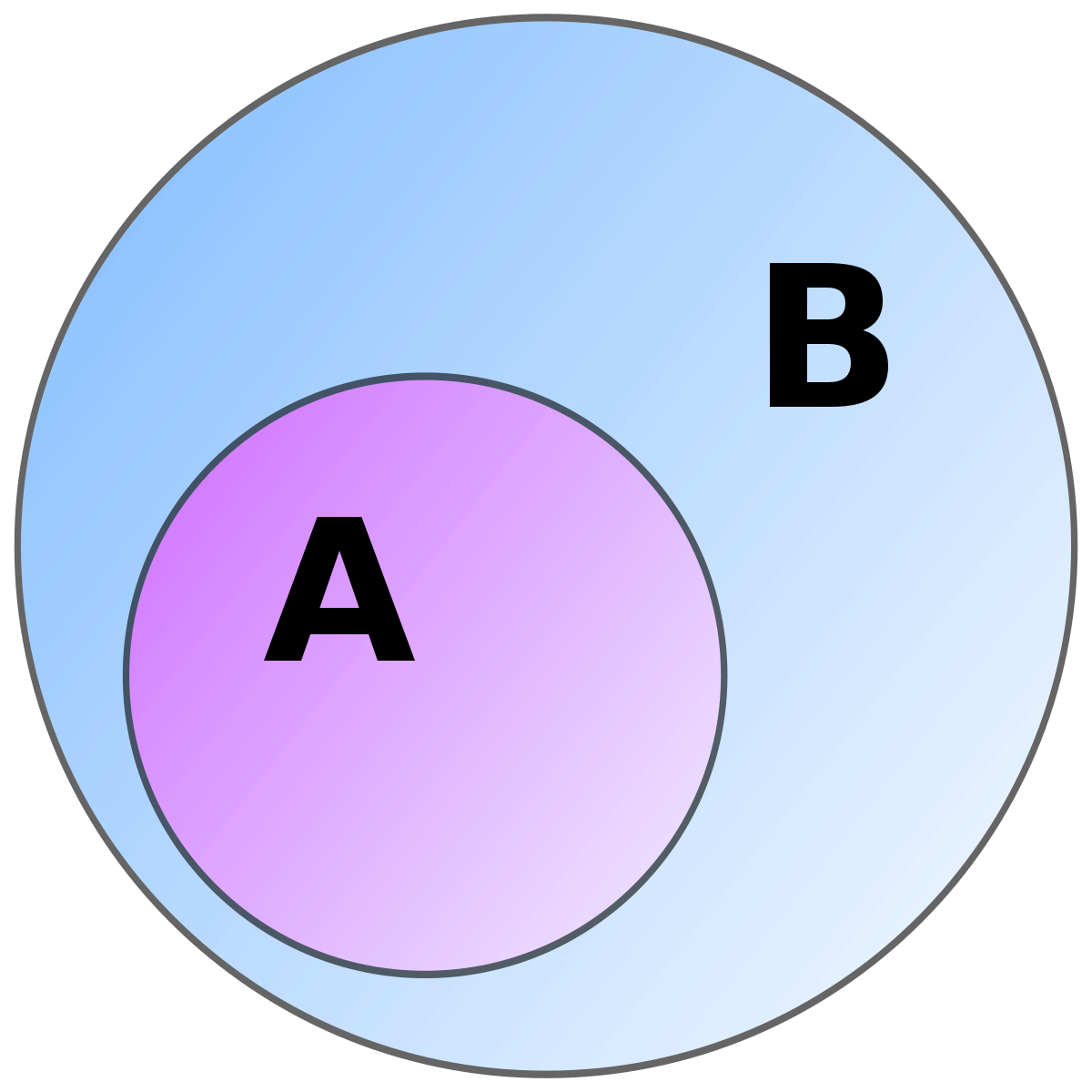
Subsets & Proper Subsets

https://upload.wikimedia.org/wikipedia/commons/thumb/b/b0/Venn_A_subset_B.svg/1200px-Venn_A_subset_B.svg.png

With reference to this image:

– A proper subset is when A lies inside B but cannot be equal to B because they don’t share the exact same elements in both sets

– A subset is when A can be equal to B because both the sets contain the exact same elements


Important Pointers

  • In sets, we should always put them in notation form when listing elements where they’re surrounded by curly brackets { } and separated by commas. e.g. A ⋃ B = {2, 3, 8}
  • The three dots (…) are called ellipsis and are used to justify that the set goes on
    e.g {1, 2, 3, 4, 5, …, 30}
  • A’ refers to everything outside A therefore A’ ⋃ A makes a universal set
  • Universal set refers to all the elements present in the set
  • Empty or null set refers to a set without any elements { }
  • n(A) refers to the. umber of elements in set A, and therefore, it shouldn’t be surrounded with curly brackets
    e.g. n(A) = 6


Simple Probability

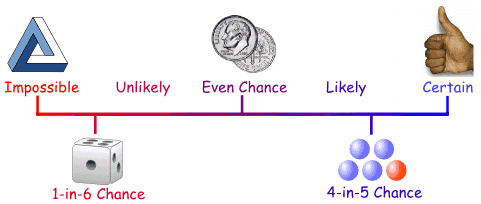
  • If an event cannot happen, the probability of it occurring is 0.
  • If an event is certain to happen, the probability of it occurring is 1
  • All probabilities lie between 0 and 1, and can be written using fractions or decimals
  • Probability is written as event/total possible outcomes, when in fraction form
http://www.mathsisfun.com/images/probability_line.gif


Independent and Exclusive Events

– Independent events are those events that are unaffected by the occurrence of others
e.g. obtaining a head on one coin and a tail on another when they’re tossed at the same time.
Keyword: ‘and’
the ‘AND’ rule:
p (A and B) = p (A) x p (B)

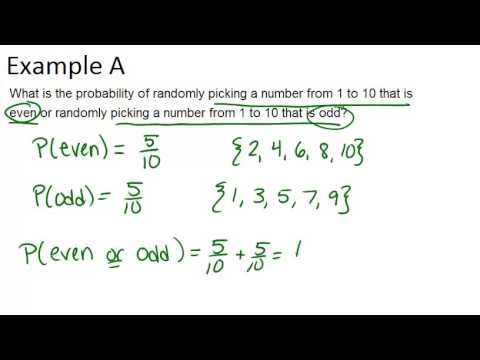
– Exclusive events are those events that cannot occur at the same time; the occurrence of one hinders the other
e.g. selecting an even number or an odd number from a set of numbers
Keyword: ‘or’
the ‘OR’ rule:
p (A or B): p (A) + p (B)


Some examples are:

https://farm8.staticflickr.com/7632/16992172896_068d5b9807_o.png


https://i.ytimg.com/vi/lsANVGnb-Yg/hqdefault.jpg


Tree Diagrams

– Tree diagrams are used to display all the possible outcomes of an event, where each branch represents a possible outcome. They can be useful to calculate the number of possible outcomes and the probability of certain outcomes.

Example 1:

data:image/png;base64,iVBORw0KGgoAAAANSUhEUgAAAToAAAChCAMAAABgSoNaAAABNVBMVEX///+l3//Z8


In this example, the probability of each final possible outcome is found by multiplying the probabilities on each branch. e.g. the probability of getting…
head, head: 0.5 x 0.5 = 0.25
head, tail: 0.5 x 0.5 = 0.25


Example 2:

data:image/png;base64,iVBORw0KGgoAAAANSUhEUgAAAUYAAACbCAMAAAAp3sK


Real Life Applications of Sets & Probability:

1. Lawyers

http://pdjlawfirm.org/wp-content/uploads/2019/01/commercial-business-lawyer.jpg

The first real life application of sets can be used between lawyers and their respective clients. A client hires a lawyer to fight for them on a case, and the decision on how to do it has to be mutual. The lawyer can either take the case to trial in court, or the opposing team may hand them a settlement offer. However, the settlement offer can only be made if it is a mutual decision between the lawyer and the client. The lawyer will advice the best way to deal with the problem however, the client has to agree whether or not he/she is willing to give up whatever it takes to put the case at rest. Therefore, the lawyer can come up with a set of ideas of his/her own, and the client can do the same. Once they’ve come to an idea that’s favourable by both sides, they can draw up a settlement offer for their rivals.


2. Card Games

https://knowledge.insead.edu/sites/www.insead.edu/files/images/2018/07/vcs_should_invest_like_poker_player.jpg

Probability can also be very useful when playing poker. This can help you in deciding how much you want to bet by examining your opponents’ skills, experience, abilities and whether or not you’re likely to be able to ‘play the man’ instead of playing the game by setting a high bet as a bluff. You can predict how likely it is for you to get a certain hand e.g. royal flush, straight flush, straight or full house. It can also help you decide whether you would like to call, raise, check or fold in a particular round. Besides that, it enables you to create the best hand possible by weighing your possible outcomes from the dealer’s flop.


3. Meteorologists

https://fiverr-res.cloudinary.com/images/t_main1,q_auto,f_auto/gigs/2618444/original/91158bc60ee8c86cde4c085caa5fe3a672fc8377/produce-a-weather-forecast-or-meteorologist-video.png

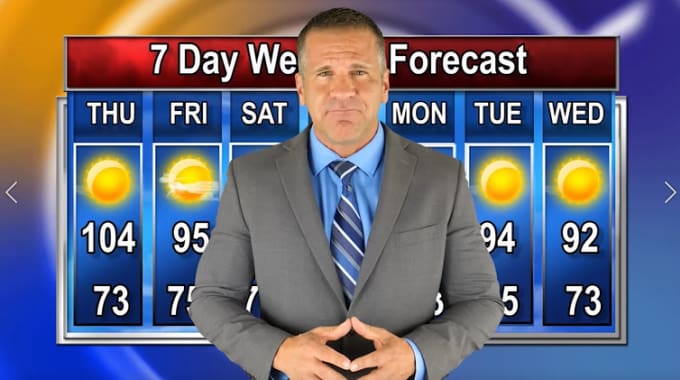
Another real life application of probability can be found in the study of meteorology. Meteorologists can’t know for sure how the weather will be tomorrow, day after or for the rest of the week. However, they predict it by using tools and instruments that can help to determine how likely it may snow, rain, shine, etc. For example, there’s a 70% chance of rain tomorrow so, this can warn people to bring an umbrella with them when they step out of the house for extra precautions. Meteorologists also examine historical data to estimate high or low temperatures, or possibly the weather pattern for the rest of the week.

eJournal 4: (Stat)isfaction From (Stat)istics?

Don’t limit your challenges.
Challenge your limits.

Jerry Dunn

Real Life Application #1

https://upload.wikimedia.org/wikipedia/commons/thumb/2/20/Uspop.svg/350px-Uspop.svg.png

Statistics can be very useful in our daily lives. One way in which it can be applied is in government agencies. These officials use statistics to plan, organize, interpret and present data in order to make decisions about economically related matters like population, health and education in a country. For example, they can indulge in research activities on population to calculate how rapidly the birth rate is growing in a certain region or they can also collect raw data from public schools regarding the pass & fail rates in a particular area. They can also see the proportion of males to females in a country or use a line graph to interpret & display the pattern of the death rate in a country due to seriously rising health issues that need to be taken care of immediately.


Real Life Application #2

https://www.answer-my-health-question.info/images/medical-error-statistics-5.jpg

Another way in which statistics can be applied to our day-to-day lives is in the science and medical field. Statistics make many areas of studies much more effective. For example, researching to see which medicines work best and how the human bodies react to treatment. Medical professionals also conduct studies in a variety of categories, e.g: by race, age, gender, nationality, etc. The graph above shows a country interpreting raw data about the cause and number of death.


Box and Whiskers Diagram

https://socratic.org/questions/how-would-you-compare-two-box-and-whisker-plots

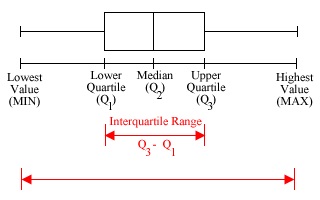
A box and whiskers diagram is a  graphical method of displaying the median, quartiles, and extremes of a data set on a number line to show the distribution of the data. To draw a box and whiskers diagram, you will need to find the min, max, Q1, Q2 and Q3.

– min: the lowest value in your set of data
– max: the highest value in your set of data
– Q1: lower quartile, which can be found using the formula: 1/4 (n + 1) th, where n is the total number of data in your set of values. The answer will then give the position of where the lower quartile is located.
– Q2: median, which can be found using the formula: 1/2 (n + 1) th
– Q3: upper quartile, which can be found using the formula: 3/4 (n + 1) th.

Once you’ve found all this data, you simply draw a number line ranging from the min to the max. Then, you draw a small vertical line on top of the min and another vertical line on top of the max. Next, draw a longer vertical line in Q1, Q2 and Q3 and simply connect them using horizontal lines.


Scientific Calculator Instructions (fx – 991 ES plus)

1. To erase all the data on your calculator:
shift → 9 → all → = → AC

2. To put it on statistics mode:
mode → stat → A + Bx

3. To input data:
Simply put in your x values one by one then use the right arrow to move to the y column and in turn, input the y values. Once you’ve finished inputting all your data, press AC.

4. Shift 1:
This function can be used to recheck your data inputted by pressing shift 1 followed by the number 2. you can also find n, mean of x, mean of y, standard deviation of x and y simply by pressing shift 1 followed by the number 4. Next, you can find A and B in the equation A + Bx, as well as the correlation (r) by pressing the number 5 after shift 1.

5. 1 VAR:
This function is used when there’s only one variable of data (commonly either x or y) To do this, you should just press mode → stat → 1 VAR. Then, just input your data in the x column. If you want a frequency column as well, you can do that by pressing
shift → mode → stat → frequency on

eJournal 3: Roller Coasting Through Seven Chapters of Math

“Mathematics is not about numbers, equations, computations, or algorithms: it is about understanding.

William Paul Thurston

Chapter 1: NUMBER

1.1 Arithmetic

– Decimals
* basic addition, subtraction, multiplication & division without a calculator

Image result for how to add decimals
http://www.coolmath.com/sites/cmat/files/images/decimals06-01.gif

In order to add decimals, we should line them up, one on top of another like shown below:

NOTE: We can also add a zero behind the decimal 4.5 as trailing zeros aren’t considered to be significant figures. Adding a zero behind the decimal will bring both the decimals up to the same length, and in turn, prove to be more comfortable/familiar to add.

For subtracting decimals, we can use the exact same method but we should just replace the addition sign with a subtraction one.

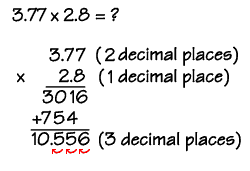
Next, multiplying decimals have the same foundation as that of adding & subtraction decimals however, it can be a bit trickier. The main difference between them is for adding and subtracting decimals, you have to line up the decimal points however, for multiplying decimals, you cannot align the decimal points. You should line up the numbers on the right hand side and then multiply the digit above with the digit below. Finally, add the products together and move the decimal point by a number of places equal to the sum of the decimal places in both numbers multiplied. An example is shown below.

Image result for how to multiply decimals
http://www.math.com/school/subject1/images/S1U1L5GL.gif

Lastly, for the division of decimals, to make it easier, we can just ignore the decimals and divide it as regular whole numbers first. Then, once we’ve done that, we should move the decimal in the answer a certain number of places to the left, depending on the sum of the decimal places in both numbers divided. Here is an example:

Image result for how to divide decimals
http://www.coolmath.com/sites/cmat/files/images/decimals10-02.gif

-Fractions
*basic addition, subtraction, multiplication & division

  1. To add fractions, we should make the denominators the same by finding the lowest common multiple. We can find the lowest common multiple by simply listing each of the denominators’ multiples until we find one that they share in common. The same goes for subtracting fractions.
  2. As for multiplying fractions, the denominator doesn’t have to be the same; all we have to do is multiply the numerators together followed by the denominators. Then, we can just simplify the answer.
  3. Lastly, for the division of fractions, it’s slightly more complicated. When you divide two fractions, you should switch the numerator and the denominator of the second fraction then simply multiply them using the method in number 2. Below is a graphical representation of the division of fractions:
Image result for how to divide fractions
https://www.wikihow.com/images/thumb/0/09/Divide-Fractions-by-Fractions-Step-3-Version-5.jpg/aid150234-v4-728px-Divide-Fractions-by-Fractions-Step-3-Version-5.jpg


1.2 Number Facts and Sequences

Number Facts:
– a whole number is referred to as an ‘integer’ (e.g. 5, -8)
– a prime number is only divisible by 1 and itself (e.g. 7, 11)
– multiples are the product results of one number multiplied by another number (e.g. the multiples of 5 are 5, 10, 15, 20, 25, 30 and so on…)
– factors are the numbers we can multiply together to get another number (e.g. the factors of 15 are 1, 3, 5 and 15)
– a square number is the result of multiplying a number by itself (e.g. 5 x 5 = 25 therefore, 25 is a square number)
– a cube number is the result of multiplying a number by itself thrice (e.g. 5 x 5 x 5 = 125, so 125 is a cube number)
-A rational number can always be written in the form a/b, where a and b are whole numbers (e.g 3/7, 3/2, 5.14, 0.6)
-An irrational number cannot be written in the form a/b (e.g. pi, square root of 2, etc) Generally, the square root of n is irrational unless n is a square number.

Highest Common Factor (HCF) & Lowest Common Multiple (LCM)
– The first step to finding the HCF or LCM of two or more numbers is to list the numbers as a product of their prime factors.
– Then, by looking at the prime factorisation, we can find the HCF by examining the elements that are present in both numbers and simply multiply them together.

Image result for finding hcf using prime factorization
https://i0.wp.com/www.cbsetuts.com/wp-content/uploads/2013/09/HCF_Prime-Factorization.png?ssl=1

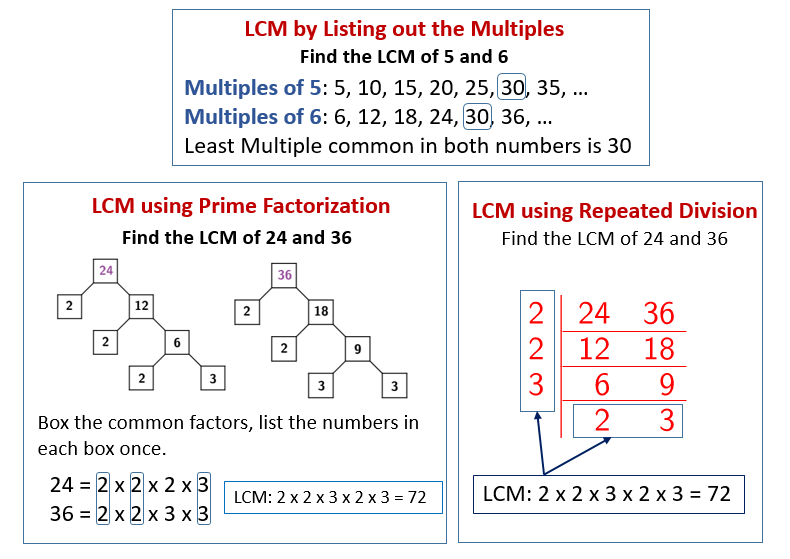
-As for finding the LCM by looking at the prime factorisation, all you have to do is box the common factors that the numbers share, and list the numbers in each box once. Then, multiply it with the remaining factors that the numbers do not have in common. Here are various methods you can use to find the LCM:

Image result for finding lcm using prime factorization
https://www.onlinemathlearning.com/image-files/xlcm.png.pagespeed.ic.kftezOPh-V.png

-Sequences, the nth term
1. in an arithmetic sequence, the difference between successive terms is always the same number

2. the expression for the nth term of an arithmetic sequence is always of the form an + b, where the difference between successive terms is equal to ‘a’ and ‘b’ can be found by looking at the terms
For example, Sequence X: 5, 7, 9, 11, 13
In sequence X, the nth term = 2n + b; when n=1, 2 x 1 + b = 5 so b = 3.

3. An = a + (n-1) d, where a is the first term of the sequence, n is the number of the term you’re looking for and d is the common difference

4. To find the sum of an arithmetic sequence, the formula is Sn = n/2 [2a + (n-1) d]

-Percentage Increase or Decrease
Percentage Profit = actual profit/original price x 100%

Percentage Loss = actual loss/original price x 100%

-Simple Interest
I = PRT / 100, where P is the amount invested, R is the rate of interest per annum and T is the number of years

-Compound Interest
Value of Investment = P(1 + r/100) to the power of n, where P is the amount invested, r is the percentage rate of interest and n is the number of years of compound interest

-Speed, Distance and Time

Image result for dst triangle
http://h3maths.edublogs.org/files/2013/06/DST-triangle-23ybav4.jpg

Chapter 2: Algebra 1

– Directed Numbers
+ and + gives a positive answer when adding numbers
– and – gives a negative answer when adding numbers
Note: to add two directed numbers with different signs, find the difference between the numbers and give the answer the sign of the larger number
e.g. +7 + (-3) = +4
+9 + (-12) = -3

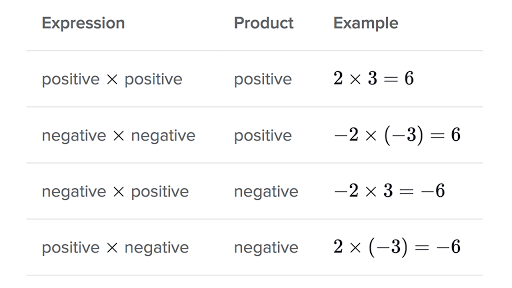
Below is the multiplication of directed numbers:

Image result for directed numbers multiplication and division
https://cdn.kastatic.org/googleusercontent/QeCNX-NQDuRTOTf_cBAuGSMWmsW82_jceiD2ceyQ_aV0WTGZxE8i6wVcEGcVwdf0WcpxlkHH5J9mjlV_oFXq24MdKA

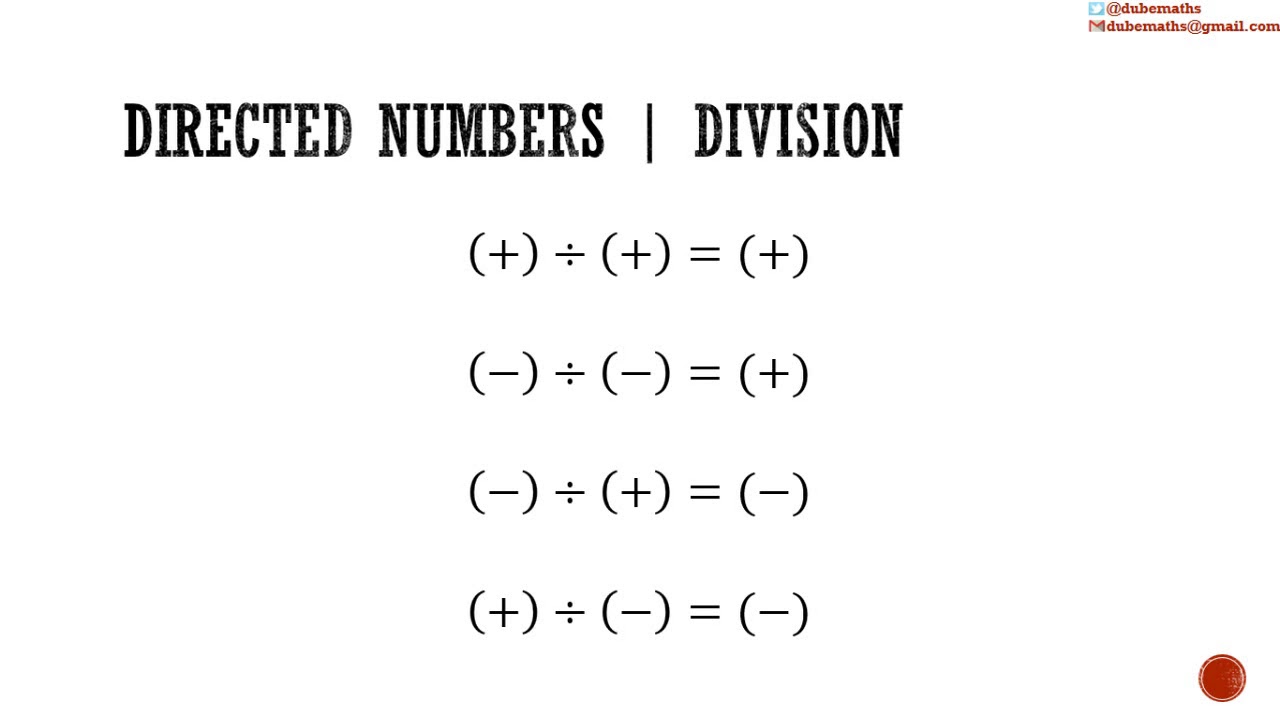
Below is the division of directed numbers:

Image result for directed numbers division
https://i.ytimg.com/vi/NUqAsCgdArM/maxresdefault.jpg


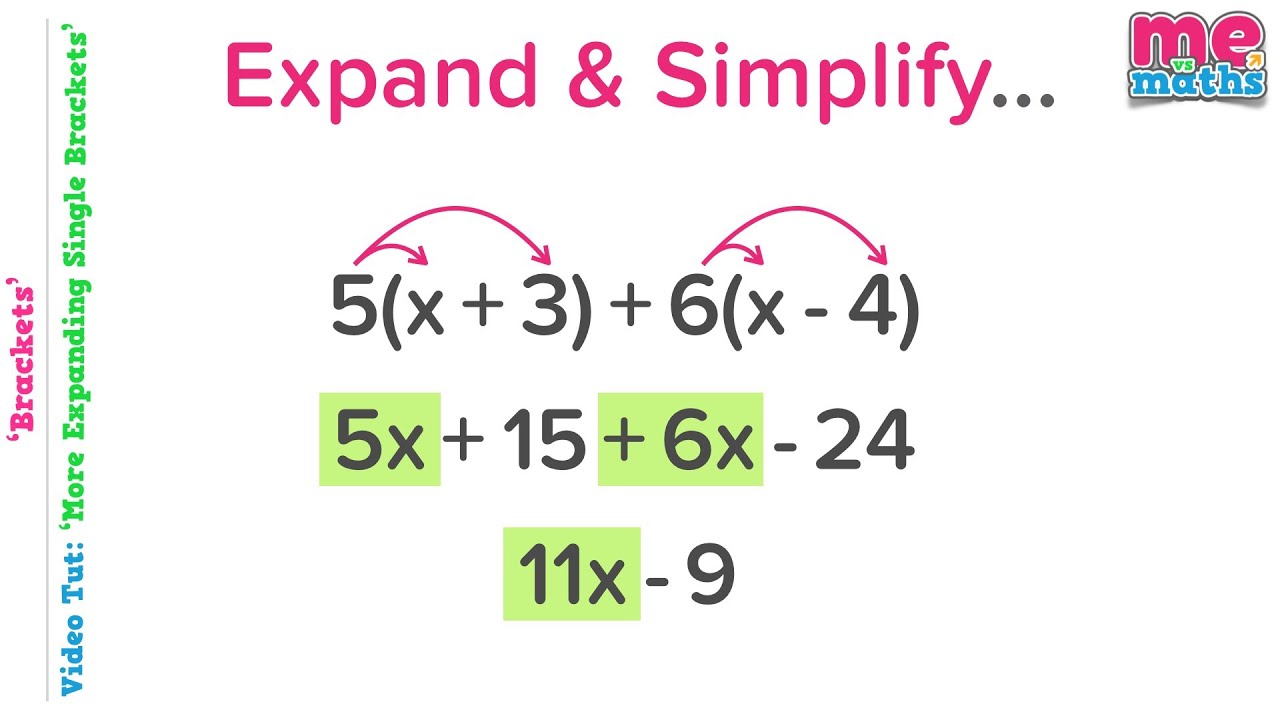
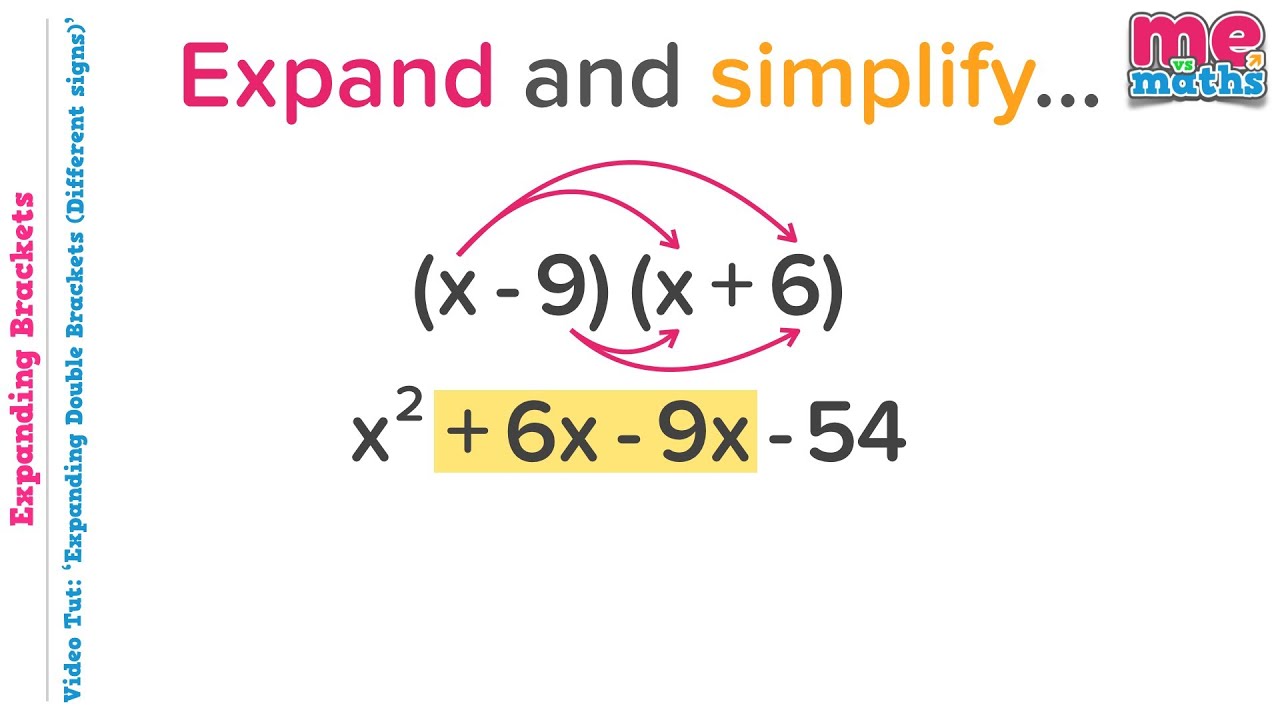
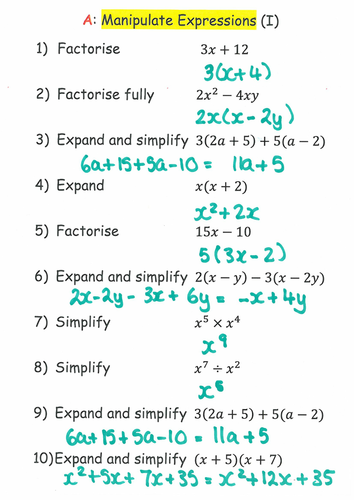
-Brackets and Simplifying
1. A term outside a bracket multiplies each of the terms inside the bracket. This is the distributive law.
2. In general:
x’s can be added with x’s
y’s can be added with y’s
x squares can be added with x squares
but they cannot be mixed.

Image result for brackets and simplifying
https://i.ytimg.com/vi/QXE8W-AD8pw/maxresdefault.jpg
Image result for brackets and simplifying
https://i.ytimg.com/vi/ZILVUNImJIE/maxresdefault.jpg
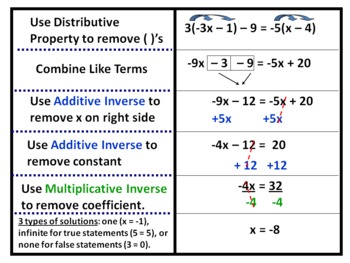
-Linear Equations

1. if the x term is negative, add an x term with a positive coefficient to both sides of the equation
2. if there are x terms on both sides, collect them on one side
3. if there is a fraction in the x term, multiply out to simplify the equation

Image result for linear equations and inequalities
https://ecdn.teacherspayteachers.com/thumbitem/Solving-Linear-Equations-and-Inequalities-Foldable-1363859872/original-337547-2.jpg


-Simultaneous equations

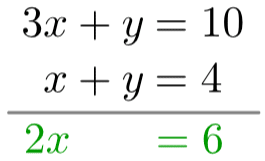
  1. Substitution Method: this method is used when one equation contains a unit quantity of one of the unknowns
Image result for substitution method
https://i.ytimg.com/vi/mP2zwOfo_v8/maxresdefault.jpg
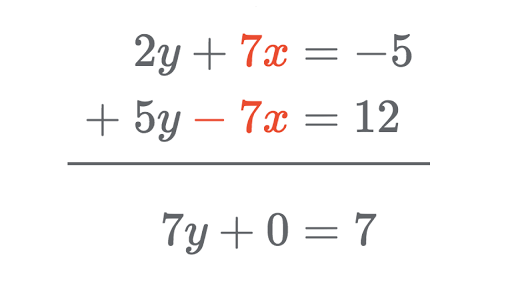
  • Elimination Method: use this method when the substitution method is unsuitable. However, some people prefer to use this method for every question.
Image result for elimination  method
https://cdn.kastatic.org/googleusercontent/5cxYSW4LL1cfgw0w3Z2jAib_n8TXjxwg9AmADsAuvgFHWwU7yRY3rhYx7mPbDgdz_i2LXVtCGF3E6o4agswj14JLoA

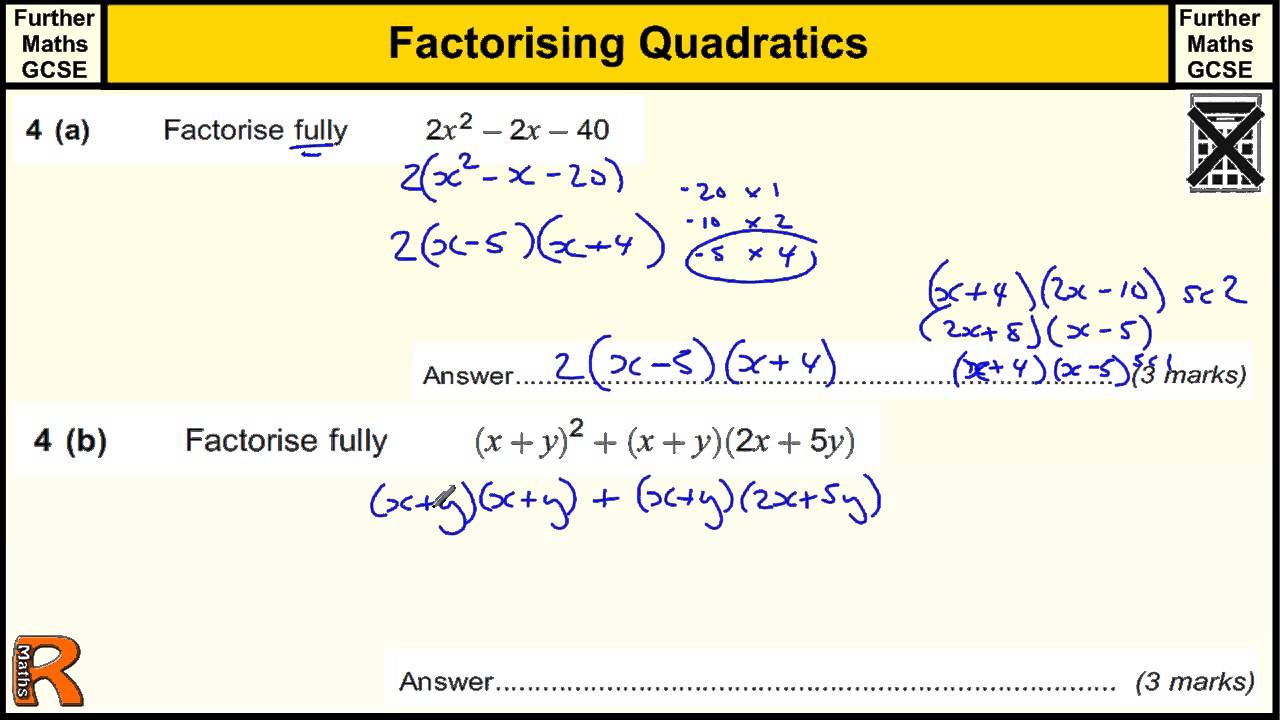
-Factorising
The reverse process of expanding expressions is referred to as factorising.

Image result for factorising
http://www.ultimatemaths.com/index_htm_files/107341@2x.jpg
Related image
https://i.ytimg.com/vi/6Et5bJ8GPRw/maxresdefault.jpg
Image result for factorising

-Quadratic Equations
the solutions of the quadratic equation ax^2 + bx + c = 0 are given by the formula

Image result for quadratic formula
https://d2jmvrsizmvf4x.cloudfront.net/05SD8dSqTYeVa85n7XZw_quadratic-formula.jpg

-Chapter 3: Mensuration

Image result for area of shape
https://i.pinimg.com/originals/19/7d/9d/197d9d2f76db76749cb16e37ed7e93f7.png

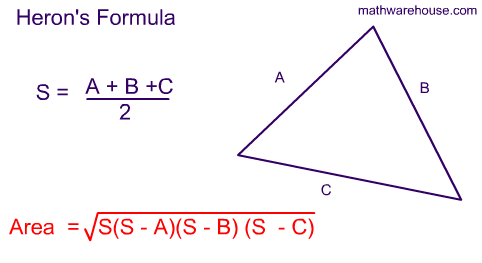
alternative formulas to find the area of a triangle includes:
– 1/2 ab sin C, where a and b are 2 of the given sides and C is the inclusive angle
– Heron’s formula: (a, b and c refers to the sides of the triangle)

Image result for heron's formula
https://www.mathwarehouse.com/geometry/triangles/area/images/herons-formula/picture-of-herons-formula-and-triangle.png
  • an alternative formula to find the area of a parallelogram is ba sin θ, where b and a are the sides of the parallelogram and θ is the inclusive angle
Image result for area and circumference of circle
https://d2jmvrsizmvf4x.cloudfront.net/p841QHLHTVaOsKgGvd7L_displayImage.aspx
Image result for arc length and sector area
https://slideplayer.com/slide/8711157/26/images/3/Formulas+for+Arc+Length+and+Area+of+a+Sector%3A.jpg
  • for the arc length, we take a fraction of the whole circumference depending on the angle at the centre of the circle
  • as for the sector area, we take a fraction of the whole area depending on the angle at the centre of the circle

-Chord of a Circle
The area of a circle cut off by a chord is called a segment. The line from the centre of a circle to the midpoint of a chord bisects the chord at right angles. The line from the centre of a circle to the midpoint of a chord bisects the angle subtended by the chord at the centre of the circle.

Image result for chord of a circle
https://qph.fs.quoracdn.net/main-qimg-cdb9cf6e75bb93c633df5134d48e70ca
  • Volume and Surface Area
Image result for volume of shapes
https://www.thoughtco.com/thmb/mOlc0tVaO4rV3ZONw5baNwIGOOM=/768×0/filters:no_upscale():max_bytes(150000):strip_icc()/surface-area-and-volume-2312247-v5-5b57857e46e0fb00251665b9.png


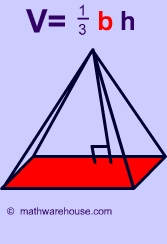
the volume of a pyramid can be found using this formula where b refers to the base area and h is the height of the pyramid.


Chapter 4: Geometry

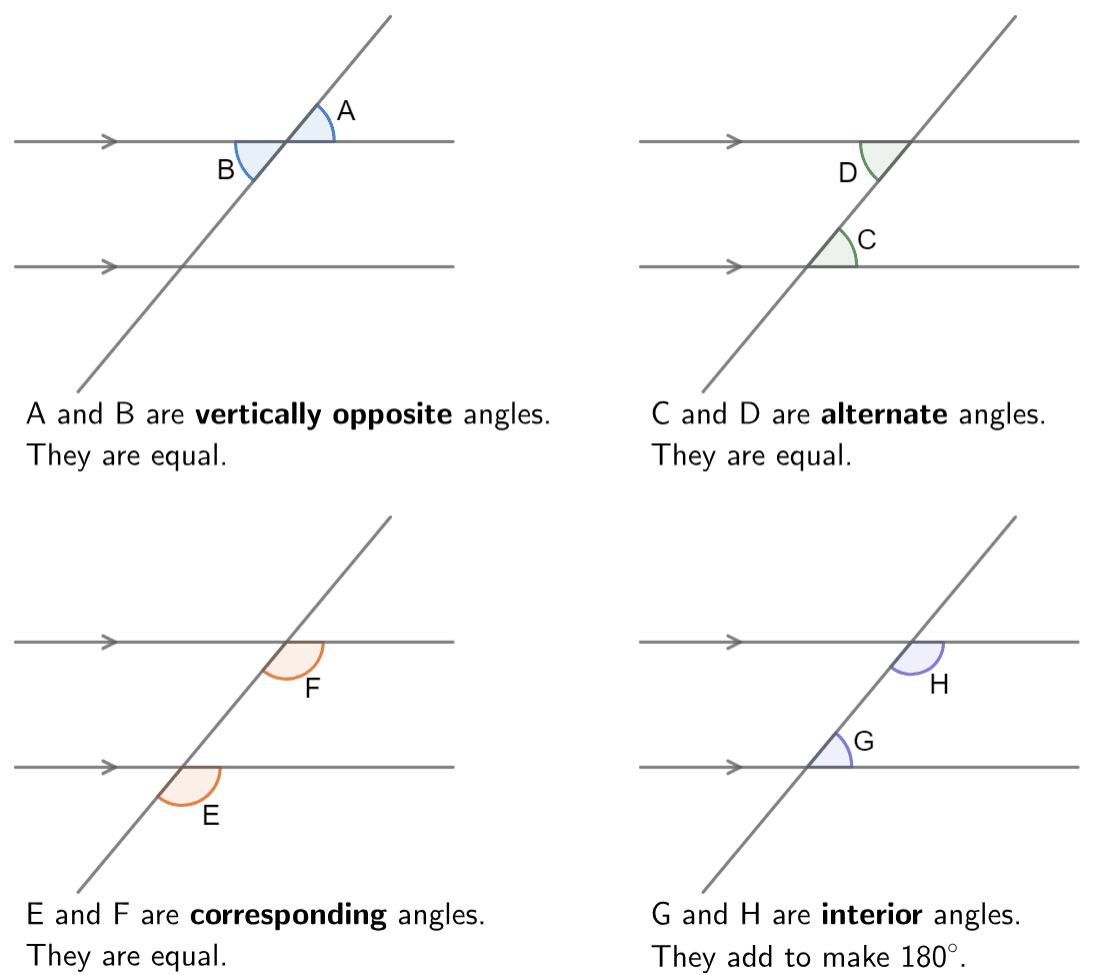
-Fundamental Results

Image result for fundamental results angles
https://mathsmadeeasy.co.uk/wp-content/uploads/2018/11/geometry-problems-foundation-figure-2.png

-Polygons
1. the exterior angles of a polygon add up to 360 degrees
2. the sum of the interior angles of a polygon is (n-2) x 180, where n is the number of sides of the polygon
3. a regular polygon has equal sides and equal angles

-Pythagoras Theorem

Image result for pythagoras
http://www.justscience.in/wp-content/uploads/2017/05/Pythagorean-Theorem.jpeg

*can only be used for right angles
*c is always referred to as the hypotenuse (longest side of the triangle)

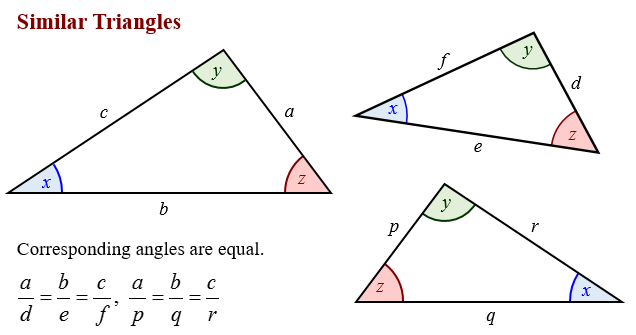
-Similarity
1. two triangles are similar if they have the same angles.
2. for other shapes, corresponding sides must also be in the same proportion

Image result for similarity of triangles
https://www.onlinemathlearning.com/image-files/xsimilar-triangles.png.pagespeed.ic.H51_j1adXG.png

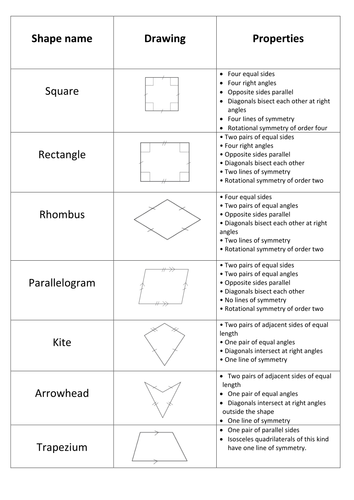
-Symmetry
“the quality of being made up of exactly similar parts facing each other or around an axis.”

Image result for quadrilaterals symmetry properties
https://dryuc24b85zbr.cloudfront.net/tes/resources/6340610/image?width=500&height=500&version=1404072897000

-Congruence
Two plane figures are congruent if one fits exactly on another. They MUST be the same size and the same shape.

Image result for congruent shapes
http://www.montgomeryschoolsmd.org/schools/woodacreses/grade2web/congruent.jpg


-Area of Similar Shapes
a quick formula to find the areas of similar shapes is:
area 1/area 2 = L1 squared / L2 squared
where ‘L1’ and ‘L2’ is the ratio of the corresponding sides

-Volume of Similar Shapes
the formula to find the volume of similar shapes is almost the same as that to find the area, just that instead of squaring L1 and L2, you have to cube it.
so… volume 1/volume 2 = L1 cubed / L2 cubed

FOR BOTH THE AREA AND THE VOLUME:
all you have to do is replace the quantities in the formula and then cross multiply to find the unknown.


-Circle Theorems, Tangents and Chords

Image result for circle theorems
https://i1.wp.com/www.greatmathsteachingideas.com/wp-content/uploads/2015/11/Circle-theorems-flash-cards.jpg?fit=1200%2C848


Chapter 5: Algebra

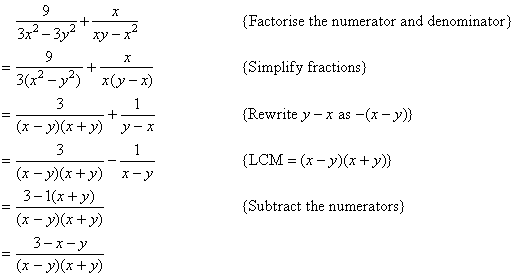
-Simplifying Fractions

Related image
https://dryuc24b85zbr.cloudfront.net/tes/resources/11230203/image?width=500&height=500&version=1519313545394
Image result for simplifying fractions algebra
https://www.mathsteacher.com.au/year10/ch11_rational/05_addition_and_subtraction/Image4739.gif


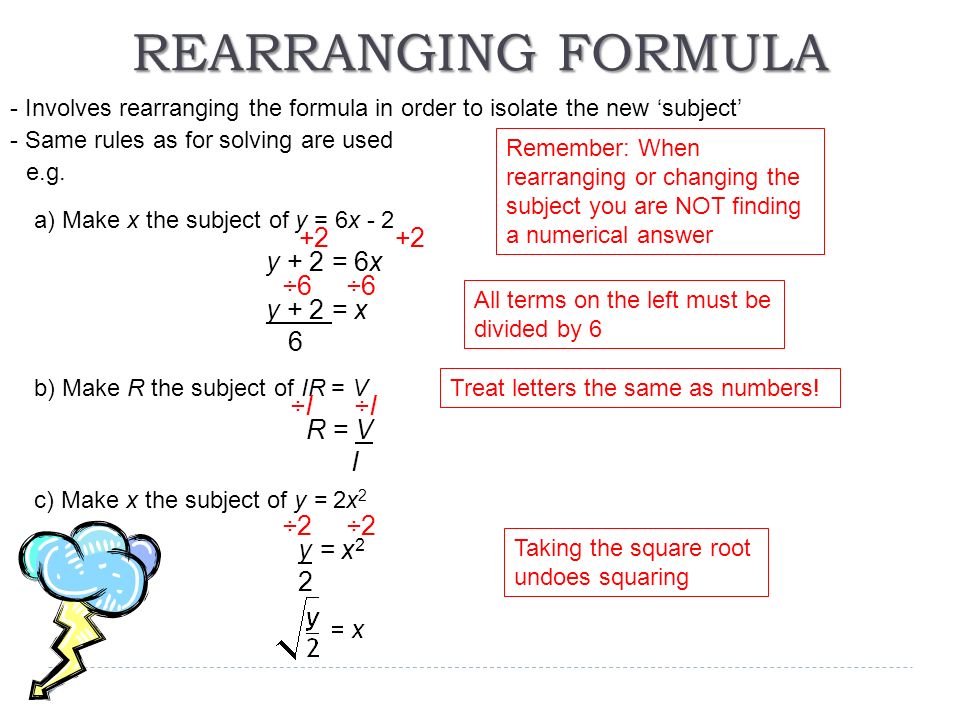
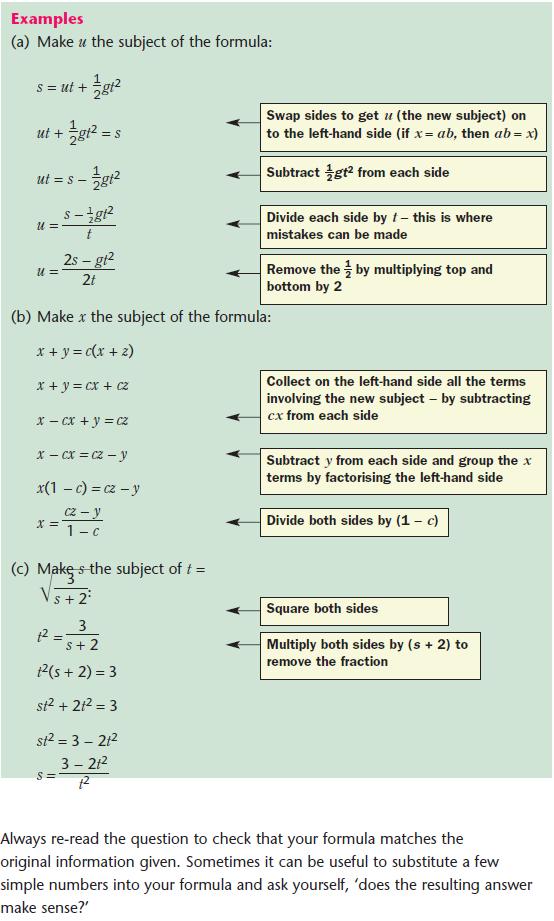
-Changing The Subject of A Formula

Image result for changing the subject of a formula steps
https://slideplayer.com/slide/7709651/25/images/37/REARRANGING+FORMULA+y+%2B+2+%3D+6x+÷6+÷6+y+%2B+2+%3D+x+6+÷I+÷I+R+%3D+V+I.jpg
Image result for changing the subject of a formula steps
https://revisionworld.com/sites/revisionworld.com/files/imce/gcse%20algebra%20changing%20formulae%20examples.jpg


-Direct Variation
where x is proportional to y
The formula for direct variation are as follows:
y = kx,
in which the k can be found through the formula
k = y/x

x and y are the variables, while k is the constant of variation.
here is an example:

Image result for direct variation
https://i.ytimg.com/vi/WGqmAmzUODM/maxresdefault.jpg

therefore, to find y in the picture above:
since we know y = 6x, and we want to find y when x = 3.5,
all we have to do is replace the x value with 3.5 like this:
y = 6 (3.5) therefore, the product will be 21.


-Inverse Variation
where x is inversely proportional to y
The formula for inverse variation are as follows:
y = k/x
and if you rearrange the formula to make k the subject…
k = y/x


-Indices

Image result for indices examples
https://i.pinimg.com/originals/c8/48/f0/c848f09230500167a49c3d3a782e110b.png


-Inequalities

basic introduction:
x > 6 means that x is greater than 6
y < 8 means that y is less than 8
if there is a line underneath the symbol…
z ≥ 3 means that y is greater than or equal to 3
t ≤ 2 means that t is less than or equal to 2

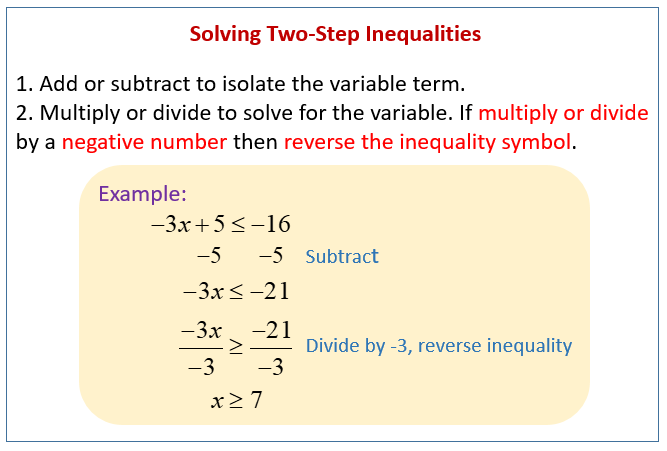
solving inequalities:
this uses the same procedure used for solving equations, just that when we multiply or divide by a negative number, the inequality is reversed.
for example: 4 > -2
but multiplying by 2 will give it
-8 > 4

other examples of inequalities include:

Image result for inequality examples
https://calculus.nipissingu.ca/tutorials/absolutevaluegifs/abs_ineq_ex2.gif
Image result for inequality examples
https://www.onlinemathlearning.com/image-files/xtwo-step-inequalities.png.pagespeed.ic.LuFZxssIhn.png


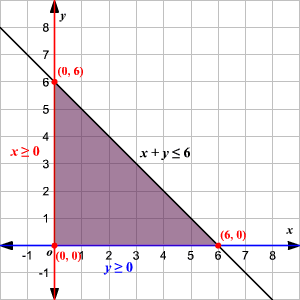
-Graphical Display
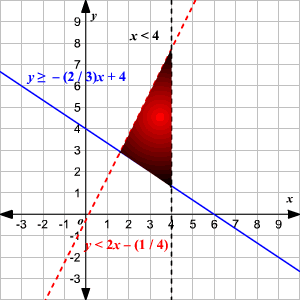
This is used to represent inequalities on a graph, especially when two variables are involved. It is represented as a region on one side of a line.

Related image
https://www.varsitytutors.com/assets/vt-hotmath-legacy/hotmath_help/topics/linear-programming/lp-1.gif
Image result for graphical display of inequalities
https://www.varsitytutors.com/assets/vt-hotmath-legacy/hotmath_help/topics/graphing-systems-of-linear-inequalities/image8.gif


-Linear Programming
the two stages of most linear programming problems are:
1. to interpret the information given as a series of simultaneous inequalities and display them graphically
2. to investigate some characteristics of the points in the unshaded solution set

Related image
http://exchangedownloads.smarttech.com/public/content/56/560463d0-7b27-4dad-a43b-b99e3a6fb788/previews/medium/0001.png


Image result for linear programming
https://www.researchgate.net/profile/Mark_Schulze2/publication/2420905/figure/fig1/AS:279378807279616@1443620506030/Graphical-solution-of-a-linear-programming-problem.png


Chapter 6: Trigonometry

-Right Angled Triangles
1. The longest side of the triangle is called the hypotenuse. It is opposite the right angle.
2. The side opposite the marked angle is called the opposite.
3. The remaining side is called the adjacent.

-Sine, Cosine and Tangent
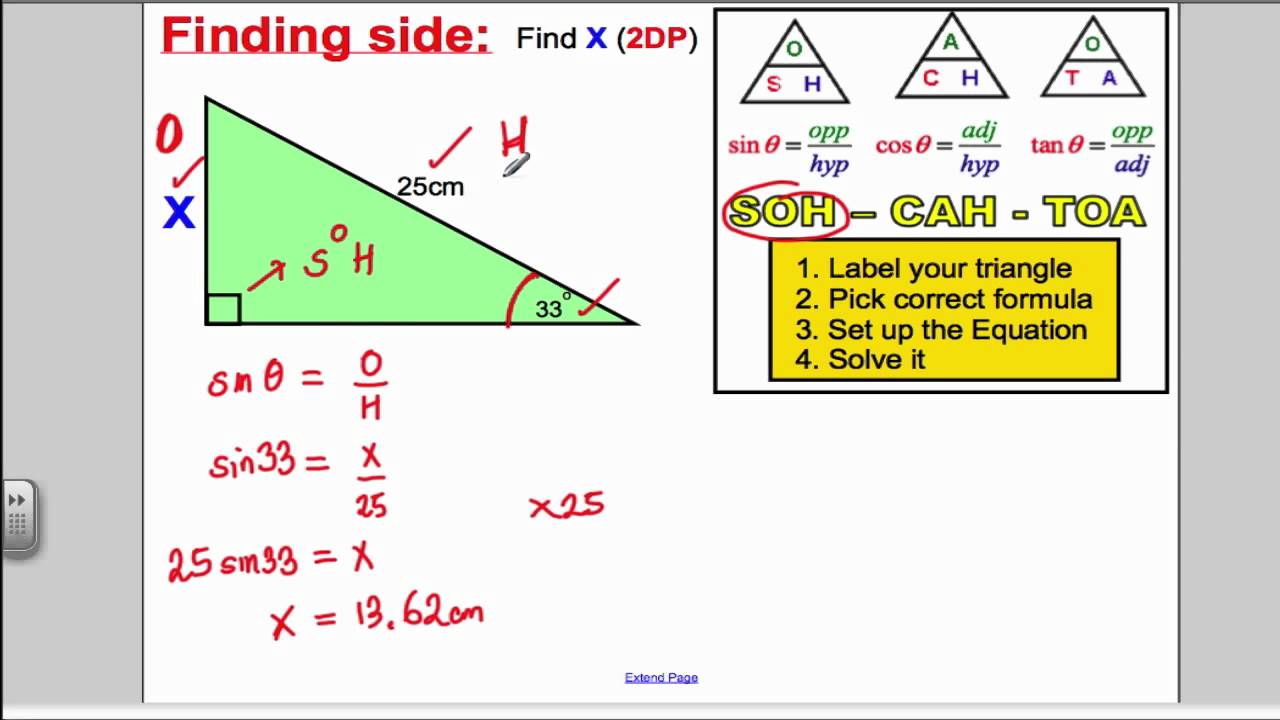
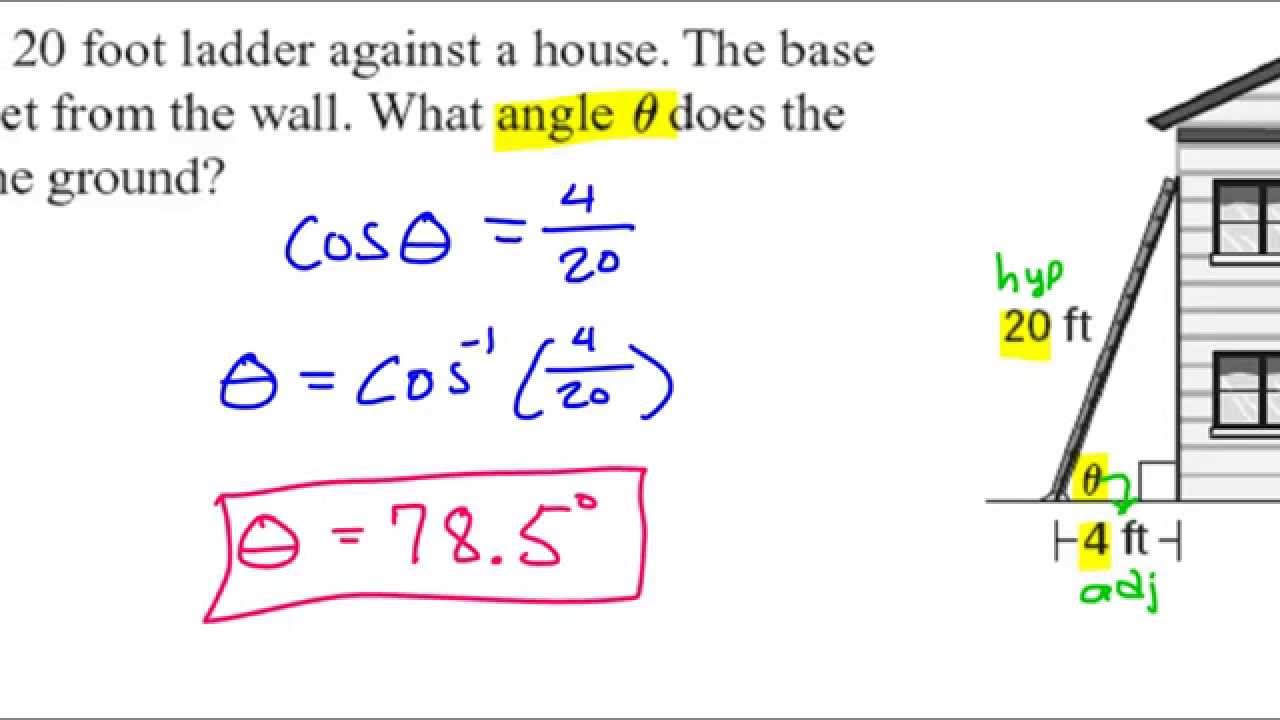
sin x = opposite/hypotenuse
cos x = adjacent / hypotenuse
tan x = opposite / adjacent

Image result for sin examples math
https://i.ytimg.com/vi/WqBDpujbtIo/maxresdefault.jpg
Image result for cos to find angle
https://i.ytimg.com/vi/C67FnYbDLNw/maxresdefault.jpg


-Bearings
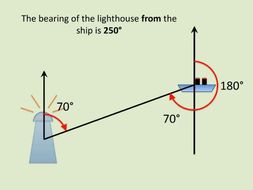
A bearing is an angle measured clockwise from North.
It is given using three digits.

Image result for bearings math
https://l.imgt.es/resource-preview-imgs/335e1953-1bd4-4bc4-9905-cd2bf50fe667%2FBearingspresentation3.crop_698x524_1%252C0.preview.jpg?profile=max500x190


-Three Dimensional Problems
In three dimensional problems, one thing you should always do is draw a large and clear diagram. It is usually also useful to redraw the triangle in which you can find the angle or side needed.

Image result for three dimensional figure

https://d1whtlypfis84e.cloudfront.net/guides/wp-content/uploads/2018/03/01075158/p2.png


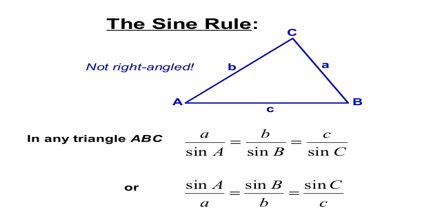
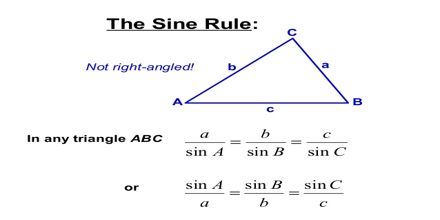
-Sine Rule
used to calculate sides and angles in some triangles where there isn’t a right angle

Image result for sine rule
http://www.assignmentpoint.com/wp-content/uploads/2016/06/Sine-Rule.jpg
  • the first formula is used to find the missing/unknown side
  • the second formula is used to find a missing/unknown angle

    NOTE: notice how in the diagram above
    a is the side opposite angle A,
    b is the side opposite angle B, etc.


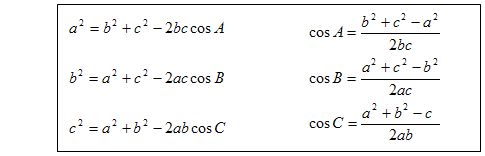
    -Cosine Rule
    we can use the cosine rule when we have either:
    1. two sides and the included angle or…
    2. all three sides
Image result for cosine rule
http://mathematics.laerd.com/maths/img/trigsinecosine/trig-sine-cosine-6.png
  • the formulas on the left side of the image are used to find the length of a side
  • the formulas on the right side of the image are used to find an angle when given all three sides

Chapter 7: Graphs

-Gradients
the gradient of a straight line is a measure of how steep it is.
we can use the formula: Y2-Y1 / X2-X1

i. lines which slope upwards to the right have a positive gradient
ii. lines which slope downwards to the right have a negative gradient

To find the distance of a line segment, we can use the formula:

Image result for distance of line segment formula


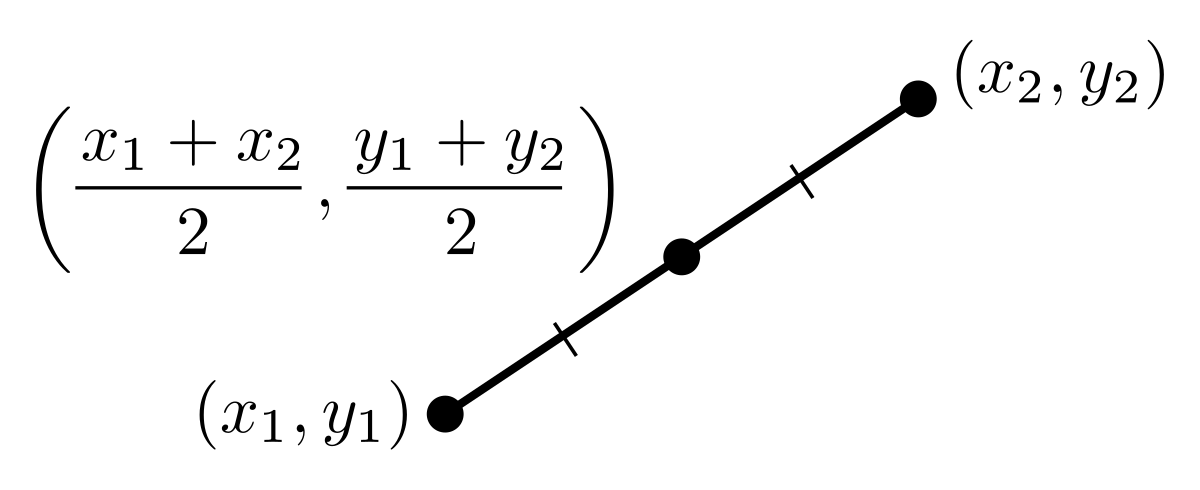
to find the midpoint of a line segment, we can use the formula:

Image result for midpoint of line segment formula
https://upload.wikimedia.org/wikipedia/commons/thumb/6/68/Midpoint.svg/1200px-Midpoint.svg.png

-The form y = mx + c
the equation of a straight line is written as y = mx + c, where m is the gradient and c is the y-intercept.

Image result for y = mx + c
https://qph.fs.quoracdn.net/main-qimg-fa47780fc4000599a86985e3553ee06e


-Plotting Curves
a. draw the graph of the function
b. draw and label axes using suitable scales
c. plot the points and draw a smooth curve through them with a pencil
d. check any points which interrupt the smoothness of the curve
e. label the curve with its equation

Note: the notation f(x) means ‘a function of x’


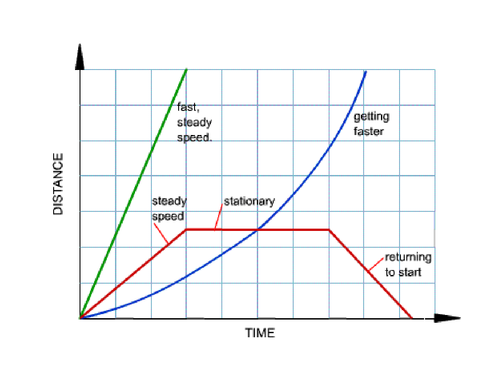
-distance time graphs
when a distance time graph is drawn, the gradient of the graph gives the speed of the object.

Image result for distance time graphs
https://dryuc24b85zbr.cloudfront.net/tes/resources/6061038/image?width=500&height=500&version=1519313844425

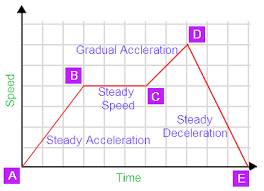
-Speed Time Graphs
The gradient of a speed-time graph represents the acceleration. The area between the curve and the time axis of the graph represents the distance travelled.


APPLICATION OF EACH CHAPTER IN REAL LIFE:

Chapter 1: Number
For this chapter, I’ll be focusing of the real life applications of mainly percentages as I find that one of the most useful factors. Firstly, percentages can be displayed in stores in terms of discounts. It is very necessary for us to be able to calculate the reduced price after the discount in order to keep track of how much money we’ve saved, etc. Next, people also quote interest rates in terms of percentages. This will require you to calculate the total amount of money you have to pay including the interest rates, whether paying directly with a full payment or in instalments. Followed by that, commissions and profits are also usually quoted in percentages. Therefore, as we can see, percentages have a lot of uses in our daily lives.

Image result for discount
http://d1hekt5vpuuw9b.cloudfront.net/assets/article/27214592931d6ec297af2a59b358c874_senior-discounts-list-all-580x326_featuredImage.jpg


Chapter 2: Algebra 1
For chapter 2, I’ll be focusing on the use of simultaneous equations in our everyday lives. Simultaneous equations can help you decide on the best deals. For example, it can help you compare prices that two different car dealers are offering for rental services. Forming an equation can enable us to compare per mile or daily rate, etc. Next, it can help an air traffic controller to form equations in order for two planes to not intersect at the same time. Lastly, it can help you choose the right job where it allows you to compare salaries, benefits and commissions.

Image result for simultaneous equations
https://mathsmadeeasy.co.uk/wp-content/uploads/2018/11/simultaneous-equations-figure-2-1.png


Chapter 3: Mensuration
In this chapter’s real life applications, I’ll be focusing on the importance of area on a day to day basis. An example of area in our daily lives is especially useful for someone that’s interested or engages themselves in real estate businesses. This is because the sizes of homes are usually measured in terms of square meters and understanding the size of your land will help you to make wise decisions on how to make best use of it, what facilities to include, etc. Another real life application of area is used by airports. Airports are designed to provide enough space for planes to take off or land, and avoiding the risks of accidents as much as possible.

Image result for real estate
http://www.realty-1.co.za/images/getImage/9011/a

Chapter 4: Geometry
The Pythagoras theorem is mainly useful in our daily lives in terms of navigation purposes. You can use two lengths to find the shortest distance in which you can travel between those points. Another way in which the Pythagoras theorem can be used is in surveying. This is especially useful for cartographers who need to calculate the numerical distance and heights between various points in order to create an accurate map.


Chapter 5: Algebra 2
Over here, I will mainly explain the daily uses of exponents in our lives. Exponents are usually used to describe how powerful or weak a computer’s memory is. (e.g. 1 gigabyte of RAM means that you have 1 x 10 to the power of 9 bytes. Next, it is used by scientists to measure earthquakes, bacterial growth or large distances (e.g. from the Earth to the moon.) Lastly, it can also be used on a pH scale to measure how acidic or alkaline a substance is or engineers can also use exponential and polynomial functions in their calculations.

Image result for computer flash drive


Chapter 6: Trigonometry
There are many uses of sin, cos and tan in real life. For example, if you want to cut a tree and know where it will fall, you can use sin from the height of your location. Next, when planning a building, you can use these functions to plan and decide how much material is needed to achieve the intended size, etc. Sin, cos and tan are also particularly important in electrical engineering, vibration analysis, acoustics, optics, signal and image processing, and data compression, etc.

Image result for building
https://upload.wikimedia.org/wikipedia/commons/thumb/a/a8/Industrial_Trust_Building_Providence_RI.jpg/240px-Industrial_Trust_Building_Providence_RI.jpg

Chapter 7: Graphs
The two main uses of distance-time graphs in real life scenarios can be for knowing the speed of an object and also for being able to calculate the position of an object at a particular time. This can be especially useful for air traffic controllers in case signal for navigation lags or is lost. As for speed-time graphs, it can be used to find the acceleration of an object (usually found in a GPS) and also to know the velocity of an object at a certain point of time. In conclusion, math may have way many more impacts in our lives than we can imagine!

eJournal 2: Application of Geometry & Trigonometry In Real Life

“Winners are not people who never fail, but people who never quit.”

– Edwin Louis Cole

Whenever we solve math problems, we may always wonder to ourselves, “At which point in my life am I ever going to need to know how to solve this? How is this ever going to benefit me in the future? Why am I wasting time stressing over problems that won’t even matter in few years’ time?” Two of the most common concepts in math are geometry and trigonometry. Whether it’s shapes, lines, angles or curves, they all make up the general topic, “Geometry.” As for trigonometry, it mainly refers to fundamental functions such as sin, cos and tan. In conclusion, it’s basically the study of the relationship between angles, lengths and heights.

The New York Times: Fashion & Style

One of the ways geometry is applied in real life is through fashion designing. To everyone who aspires to become fashion designers in the future, you may think that you don’t need any other skills besides art, creativity and other design-related expertise however, math, especially geometry, can be way more vital in this field than you could ever expect.

In the image above, it displays 3 models from a fashion show during Paris Fashion Week. The fashion show was titled “Designers Outline a New Geometry.” Geometry was portrayed in many different ways in the fashion runway, whether it was linear or circular cutting, asymmetrics, folded squares, sharp cutting or soft folds, the fashion show definitely wouldn’t have been complete without the geometric details in each and every clothing piece.

The shapes and lines that made up the outfits in the picture above definitely needed a lot of careful planning and design. Without the application of geometry, the designers wouldn’t have been able to achieve the theme and aim of the fashion show. They needed to use a lot of mathematical knowledge to turn their ideas into masterpieces with the use of lines, curves, symmetry, loops, angles, transformations and many more.

embibe.com

This picture shows one of the most common applications of trigonometry in real life – finding the height of buildings. In this case, this is a very basic and straightforward problem involving geometry as all you have to do is use your knowledge of finding the length of a side of a right triangle using sin, cos and tan. Since the angle of elevation is already given as 79.9 degrees, and the length of the base is 100 ft, we can simply label the missing height as x. The height is opposite to the angle, 79.9, and the length of 100ft is adjacent. Therefore, we can use the tan function. We can work out the height of the monument by the working as follows:

since tan x = opposite/adjacent,

cos 79.9 degrees = x/100

x = 17.54 ft

eJournal 1: Numbers Speak Louder Than Words

“Pure mathematics is, in its own way, the poetry of logical ideas.”

Albert Einstein
R

REFLECTION #1:
In part (b) ii, I made a very silly mistake by not referring to my answer in part i, knowing very well that the questions are related to each other. On top of that, my answer in part i was correct, which made it way easier to get a right answer in part ii. After factorising the equation in part i and obtaining the answer (y-7)(y+12), from that, I can easily make the equations: y-7=0, and y+12=0. From that, we can switch the numbers 7 & 12 to the other side of the equation and therefore, obtain the values y=7 and y=-12. Moving to part (b) ii, I could’ve just replaced the values with 7 and -12 however, we know that it’s impossible for a side of a rectangle to be negative. Therefore, since we know that the value of y is 7, and the equation to find the length of the rectangle is y+5, we can just replace y with 7 and then add it up. We will then obtain the answer of the length of the triangle as 12 cm because 7+5=12. After finding the values of the breadth and length of the rectangle, we can find its perimeter simply by adding up the values of all 4 sides of the rectangle. So, 7+12+7+12 is equal to 38 cm.


REFLECTION #2:
This question is again, something to do with rectangles, in which I made a very silly mistake again. However, in this case, I simply forgot the concept of upper & lower bounds, which indeed proves to be a very easy concept to understand. A lower bound is the smallest value that would round up to the estimated value while an upper bound is the largest value that would still round up to the particular estimated value. For example, if the height of a child is rounded to 100 as the nearest 10, its lower bound would be 95 and its upper bound would be 105. In the case of the question above, the rectangle has a length of 64mm therefore, as the answer to part a, the lower bound of the length of the rectangle would be 63.5 mm because it’s rounded correct to the nearest millimetre. As for part b, since we already know that the lower bound for the length of the rectangle is 63.5 mm from part a, we just have to find the lower bound for the width of the rectangle. It’s given that the width is 37 mm to the nearest millimetre, therefore, its lower bound would be 36.5 mm. So, to find the perimeter, all we have to do is add up all the lower bounds of the 4 sides of the rectangle therefore, 63.5 + 36.5 + 63.5 + 36.5 is equal to 200 mm.


REFLECTION #3:
This question is about calculus and involves the expanding of expressions as well. This is actually a very easy question, which of course, I messed up again. I got almost all the steps right, except for when I made a careless mistake in factorising. Besides that, the question also asked for the gradient of the curve, in which I used the formula m=Y2-Y1 over X2-X1 and didn’t realise that dy/dx is already the gradient function. I made a mistake in expansion and therefore, the expression I should’ve obtain after deriving should’ve been -4x to the power of 3 + 22x + 24. Once that’s done, since the question asks the gradient of the curve when x=1, we can simply just replace the x values in the equation with 1, and eventually obtain the answer that’s 42.A

ADVICE FOR READERS:
Math isn’t something you should give up on. It’s very easy to make mistakes in math, especially when the problem is overly complicated, includes a lot of steps, or maybe involves the memorising of several formulas. Despite all this, math can actually be fun and easy when you actually understand the concepts of it. Everyone has their own ‘inner mathematician’ that is waiting to be discovered. Therefore, whenever you make a mistake, don’t lose hope and think “Math just isn’t my subject.” There’s always room for improvement and we can all understand math, if we put in some effort from our side. We may get annoyed at the fact that math keeps chasing it’s x and then has the audacity to ask for y, or whenever there’s problems about trigonometry, we might go like “I didn’t sine up for this.” We might see math as torture, but it actually teaches us a lot of analytical and reasoning skills, which is indeed, very beneficial for us. So, we should try our best to stop seeing math as a burden, but as our passion.